For many years, Indian brands treated rural markets as an afterthought: a place to sell cheaper products once urban markets were covered. That view no longer holds. Rural India is where a large share of India’s consumption growth is now coming from, where most new internet users live and where many categories are still far from saturated.
Rural marketing has moved from a specialist activity to a core growth strategy for brands in FMCG, consumer durables, automobiles, agri inputs, financial services, telecom, healthcare and more. This article explains what rural marketing is, why it has become so important in the Indian market and how brands can build an effective rural strategy.
What Is Rural Marketing?
Rural marketing is the process of planning and carrying out marketing activities designed for people in villages and small towns. It covers the development, pricing, distribution and promotion of products and services that meet rural needs and aspirations.
Rural marketing works in three directions:
- Urban to rural: companies selling products and services, such as FMCG goods, two-wheelers, phones, insurance and fertilisers, to rural consumers.
- Rural to urban: farmers, cooperatives and rural producers selling agricultural produce, dairy products, handicrafts and other goods to urban markets.
- Rural to rural: trade within rural areas, such as local sale of livestock, tools, seeds and services.
For most brands, rural marketing refers to the first of these: reaching and winning rural consumers, retailers and influencers.
Why Rural Marketing Is Important in the Indian Market
1. Rural India Is the Majority of the Market
According to the 2011 Census, about two-thirds of India’s population lives in rural areas. In several large states, such as Uttar Pradesh, Bihar, Madhya Pradesh, Rajasthan and Odisha, the share is even higher. No brand that wants national scale can ignore this many consumers.
2. Rural Consumption Is Rising and Catching Up With Urban India
The gap between rural and urban spending is narrowing steadily. According to the government’s Household Consumption Expenditure Survey (HCES), the average monthly per capita consumption expenditure in 2023-24 was ₹4,122 in rural India and ₹6,996 in urban India. The survey found that the urban-rural gap in spending fell from 84 per cent in 2011-12 to 71 per cent in 2022-23, and further to 70 per cent in 2023-24. Rural per capita spending also grew by about 9.2 per cent in 2023-24, compared with 8.3 per cent in urban areas.
Importantly, rural households are spending more on non-essentials. Non-food items made up about 53 per cent of rural household spending in 2023-24, with conveyance, clothing and footwear, entertainment and durable goods among the largest categories. This signals rising demand for products that go well beyond basic necessities.
3. Rural Demand Is Driving FMCG Growth
Rural markets have been a key engine of recent FMCG growth. According to NielsenIQ, in the October to December 2024 quarter, rural volume growth rose to 9.9 per cent, about twice the urban rate, and rural areas outpaced urban ones across most regions of India. In the same quarter, urban markets still accounted for 62 per cent of FMCG volume and rural markets for 38 per cent, which shows both the size of rural demand today and the room it has to grow.
4. Rural India Is Now Digitally Connected
Digital access has changed how rural consumers discover and evaluate products. According to the Internet in India Report 2025 by IAMAI and Kantar, rural India accounts for 57 per cent of India’s 958 million active internet users, about 548 million people, and is growing at almost four times the pace of urban India.
Rural digital behaviour also has its own features. The same report found that 18 per cent of users go online through someone else’s phone, and nearly 80 per cent of these shared-device users are in rural areas. Brands that understand these patterns can reach rural audiences through regional-language video, WhatsApp and social media at a far lower cost than traditional mass media.
5. Aspirations and Behaviour Are Changing
Better education, road connectivity, mobile phones and exposure to media have raised rural aspirations. Younger rural consumers in particular are more willing to try new brands, upgrade to better products and research purchases online. Non-farm incomes from construction, trade, transport, services and small manufacturing are also making rural household incomes more diverse and less dependent on a single harvest.
6. Many Categories Are Still Underpenetrated
In urban markets, most categories are crowded and competition is intense. In rural markets, penetration of many products, from packaged foods and personal care to appliances, insurance and financial services, is still much lower. This creates room for growth, and brands that establish trust early often enjoy strong long-term loyalty.
7. Government Investment Is Improving Rural Infrastructure
Investment in rural roads, electrification, housing, banking access, digital infrastructure and agricultural schemes has made rural markets easier to reach and serve. Programmes such as the Agriculture Infrastructure Fund and the expansion of banking through the Jan Dhan Yojana have also increased the flow of money into rural economies. Ascent’s articles on the 20 lakh crore package and the agri economy and financial services for rural markets explore these developments.
8. Rural Areas Are Also a Source of Supply
Rural marketing is not only about selling to villages. Agricultural produce, dairy, spices, handicrafts and other rural goods increasingly reach urban and export markets through branded value chains. Companies in food processing, agri trading and retail rely on strong rural relationships for sourcing, which makes rural engagement a strategic priority on both sides of the business.
Key Challenges in Rural Marketing
Rural markets offer strong potential, but they also require a different approach.
| Challenge | What It Means for Brands |
| Geographic spread | Thousands of dispersed villages make distribution and last-mile reach costly |
| Seasonal incomes | Demand rises and falls with harvests, monsoons and festivals |
| Language and cultural diversity | Messaging must be adapted to local languages and customs |
| Trust and brand awareness | Rural buyers prefer familiar brands and rely on word of mouth |
| Limited retail infrastructure | Small shops with little shelf space and limited credit |
| Media fragmentation | TV, digital, radio and print reach vary widely between regions |
How Brands Can Build an Effective Rural Marketing Strategy
Start with research. Understand the audience, their buying behaviour, crop and income cycles, retail networks and local influencers before planning campaigns. Ascent’s rural market research and strategic rural planning services support this stage.
Get the product and price right. Smaller pack sizes, durable products, easy financing and value-focused offers often matter more in rural markets than premium features.
Build distribution through hubs. Use larger villages and small towns as distribution centres to reach surrounding villages efficiently. Ascent’s article on Rurban areas and how marketers use them explains this approach, and our rural distribution planning service puts it into practice.
Communicate in the local language. Simple, relatable messages in regional languages and dialects work far better than translated urban campaigns.
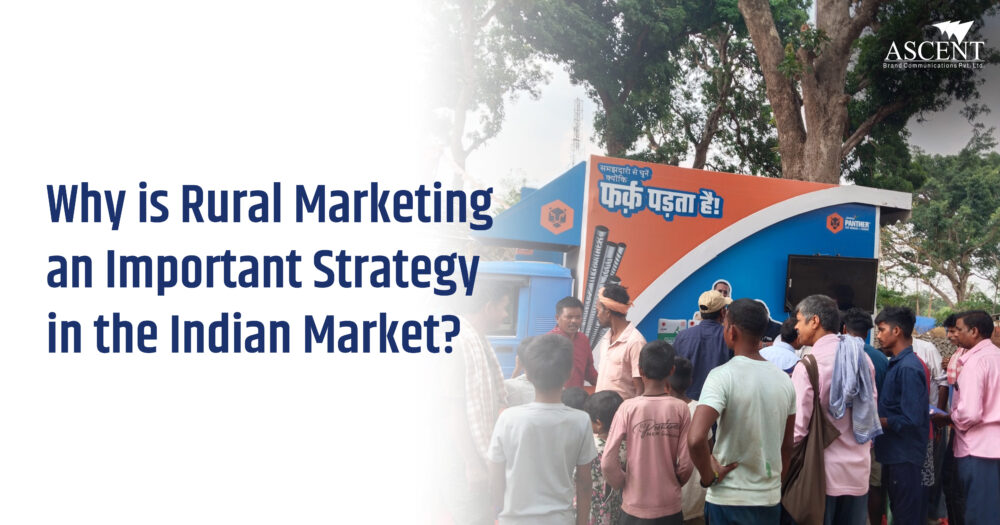
Engage people where they gather. Weekly haats, mandis, melas and religious gatherings bring large, relevant audiences together. Ascent’s BTL marketing services, rural van marketing and farmer meets are built around this.
Win the retailer and local influencers. Shopkeepers, progressive farmers and community leaders strongly influence rural purchases. See Ascent’s rural retail visibility and rural influencer marketing services.
Combine on-ground and digital. Use regional-language video, WhatsApp and social media to extend the reach of field activities. Ascent’s articles on social media strategies for rural market penetration and how rural India is consuming YouTube cover this in more depth.
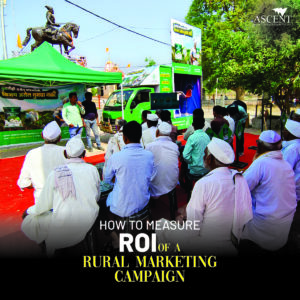
Measure and refine. Track reach, leads and sales by district and season, and use the results to improve each campaign. See Ascent’s guide on measuring the ROI of a rural marketing campaign and our checklist of 10 points to remember while devising any rural marketing campaign.
Rural Marketing in Practice: Ascent Campaign Examples
Ascent has planned and executed rural campaigns for leading brands across several categories. A few examples:
- Financial services: For TVS Credit’s “Samridhi ka Shubharambh” campaign across Uttar Pradesh, Rajasthan and Madhya Pradesh, Ascent combined brand activation, telemarketing, storytelling and interactive games to explain tractor financing and loan products to farmers and to identify potential agents.
- Building materials: UltraTech Cement’s “Baat Ghar Ki: On Wheels” campaign took the brand’s message directly into rural communities through mobile outreach.
- Agri inputs: Ascent supported farmer engagement for Syngenta Paahi (HPH 2050) and product communication across four hybrid seed launches under “Khet Se Bazaar Tak”.
- Animal feed: Ascent delivered social media marketing for Godrej Agrovet’s cattle feed brand, reaching dairy farmers through digital channels.
Frequently Asked Questions
What is rural marketing?
Rural marketing is the planning and execution of marketing activities for people in villages and small towns. It includes developing, pricing, distributing and promoting products and services for rural consumers, as well as marketing rural produce to urban markets.
Why is rural marketing important in India?
Rural India is home to about two-thirds of the population, rural consumption is growing faster than urban consumption, and rural areas now account for the majority of India’s internet users. Many categories are also less saturated in rural markets, offering strong growth potential.
What are the main challenges of rural marketing in India?
Key challenges include dispersed geography, seasonal incomes, language and cultural diversity, low trust in unfamiliar brands, limited retail infrastructure and fragmented media reach.
What strategies work best in rural marketing?
Effective strategies include market research, right-sized products and pricing, hub-and-spoke distribution, local-language communication, activations at haats and mandis, retailer and influencer engagement, digital follow-up and careful measurement.
Is digital marketing effective in rural India?
Yes. Rural India now has more internet users than urban India. Regional-language video, WhatsApp and social media work well, especially when combined with on-ground activities such as van campaigns and farmer meets.
Conclusion
Rural marketing is no longer optional for brands that want to grow in India. Rural consumers are spending more, adopting digital channels faster and looking for brands that understand their needs. At the same time, rural markets reward brands that invest in research, local communication, strong distribution and genuine trust.
With more than 25 years of experience and a pan-India network, Ascent helps brands plan and execute strategic rural marketing programmes that turn rural potential into measurable growth. Explore our integrated rural marketing services or view our rural marketing case studies.