Most business leaders now recognise the potential of rural India. What is less widely understood is how differently rural markets work, and how easily a well-funded campaign can fail when it is built on urban assumptions.
Rural consumers are not passive buyers who accept whatever is offered. They are careful with money, loyal to brands they trust, strongly influenced by their community and increasingly well informed. They compare options, ask around and, more and more often, look things up online before they buy.
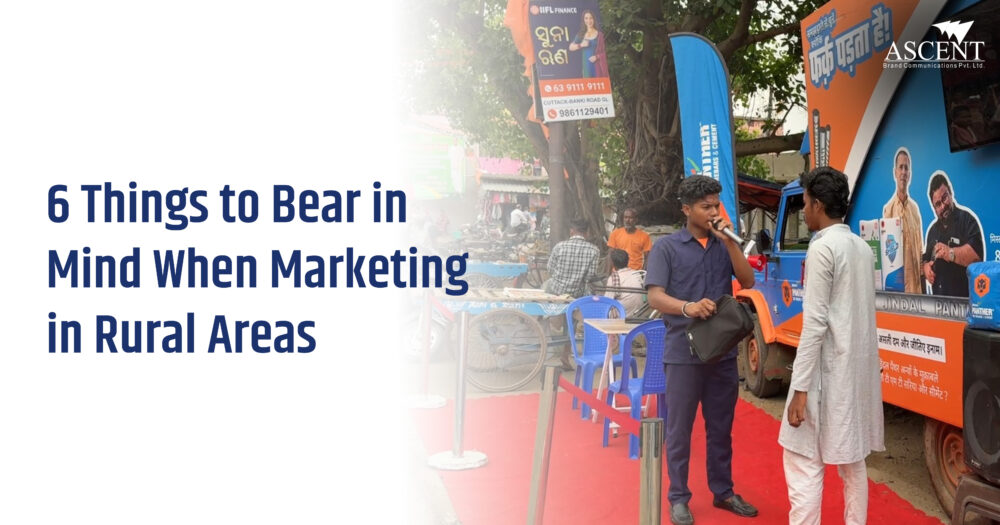
For companies and rural marketing agencies, this means rural strategies have to be built for rural consumers from the start. Here are six things every marketer should keep in mind before planning any move into rural markets.
1. Understand What Rural Consumers Prefer and What They Can Afford
Rural preferences often differ from urban ones, and one approach will not suit every market. Marketers need to start at ground level and understand what rural buyers actually value.
Take tractors as an example. A farmer does not simply want the most advanced tractor available. He wants one that suits the size of his landholding and the crops he grows, is fuel-efficient, is easy and affordable to repair locally, holds its resale value and can be financed on terms that match his harvest income. A brand that promotes high-end features without addressing these concerns is unlikely to succeed, however good the product is.
The same thinking applies across categories. Rural buyers look for durability, value for money, visible proof that a product works and reliable after-sales service. Preferences also have to be balanced against budget. Even when a consumer likes a product, income and cash flow often decide whether and when they buy. This is why smaller pack sizes, entry-level variants and easy financing options play such an important role in rural markets.
2. Research the Market Before You Enter
Rural India is vast and diverse. Before committing to a launch, relaunch or expansion, brands need a clear picture of the ground reality. As the saying goes, know the depth of the water before you dive in.
Rural market research is valuable for many objectives, including:
- New product launches and relaunches.
- Brand extensions into new categories or regions.
- Rural retail expansion and distribution planning.
- Retailer and customer satisfaction studies.
- Competitor analysis.
- Testing pricing, packaging and messaging.
Good research covers demographics, income patterns, crop and seasonal cycles, media habits, retail networks, local influencers and the attitudes and motivations that shape buying decisions. It combines quantitative surveys with qualitative methods such as village visits, retailer interviews and group discussions. Ascent’s rural market research service is designed to provide this foundation.
3. Validate Your Assumptions With Real Data
Many rural campaigns go wrong because they are built on assumptions that were never tested. Before moving ahead, validate key data points about consumer attitudes, buying behaviour, distribution and pricing.
Understanding consumer psychology is central to this. Rural buying decisions are often shaped by family discussion, community opinion and the advice of trusted people such as the local retailer, a progressive farmer or a village elder. Rural consumers are also more likely to engage with a brand when they feel included and respected, rather than simply sold to.
Once you understand how decisions are made, check that your distribution and pricing plans fit those decisions. A small pilot in a few representative districts is one of the most effective ways to validate a strategy before scaling it. It shows how consumers respond to the product, the price, the message and the channel, and it reveals practical issues that research alone may miss.
4. Build an Integrated Rural Marketing Plan
Rural success rarely comes from a single activity. Market development, campaigns, distribution, retail visibility and on-ground events all need to work together.
A strong rural marketing plan usually includes:
- Brand positioning: how you want rural consumers to see your brand, since the first impression often lasts.
- Segmentation and buyer personas: who you are targeting, from farmers and shopkeepers to homemakers and young first-time buyers.
- Channel and distribution strategy: how products will reach villages, often through a hub-and-spoke model built around larger villages and small towns. See Ascent’s article on Rurban areas and how marketers use them.
- Communication and content: local-language messages delivered through the right mix of van campaigns, farmer meets, folk media, retail branding and digital channels.
- Competitor analysis: as rural markets grow, competition grows too. Track competitor activity and adjust your plan accordingly.
- Tracking and review: regular measurement to spot new opportunities and areas for improvement.
Ascent’s strategic rural planning, rural conceptual planning and rural distribution planning services help brands bring these elements together.
5. Think Long Term
Rural markets reward patience. Trust takes time to build, and rural consumers often take longer than urban ones to adopt a new product or brand. Once they are convinced, however, they tend to be loyal and to recommend the brand to others.
The long-term trends are also strongly in favour of rural markets. According to the government’s Household Consumption Expenditure Survey, the gap between urban and rural spending fell from 84 per cent in 2011-12 to 70 per cent in 2023-24, showing that rural consumption has been catching up steadily. Rural India also now accounts for 57 per cent of the country’s active internet users, about 548 million people, according to the Internet in India Report 2025 by IAMAI and Kantar.
Rural purchasing power has also been supported by investment in irrigation, rural roads, electrification, housing, banking access and agricultural schemes. For more on why these trends matter, see Ascent’s article on why rural marketing is an important strategy in the Indian market.
A long-term strategy helps you set realistic expectations, plan investment across several seasons and build a presence that competitors find hard to replicate. Do not judge success on a single campaign, and do not be discouraged by a slow start. Small adjustments often make a big difference.
6. Do Not Rely on a Generic Plan
Rural India is not one market. Language, culture, crops, festivals, income levels, retail structures and even local regulations vary widely from one region to another.
Consider a company based in Chennai launching a product for rural Rajasthan. The climate, language, farming patterns, festivals and buying habits in rural Rajasthan are very different from those in rural Tamil Nadu. A plan that works well in one region may fail completely in the other.
Treat each region as a distinct market. Adapt messaging, creative, pack sizes, pricing, channels and timing to local conditions, and involve people who understand the area. The more effort that goes into local adaptation, the better the results.
An illustrative example: A Chennai-based pump manufacturer entering rural Rajasthan might find that farmers there rely heavily on deep borewells and face irregular power supply, while its home market is more familiar with surface water irrigation. Its messaging would need to focus on performance at depth and under low voltage, its demonstrations would need to be held in the local context, and its dealer network would need to be built around the region’s key market towns. Communication in Hindi and Rajasthani, timed to the rabi sowing season, would be far more effective than a translated version of its Tamil Nadu campaign.
Bringing It Together
These six principles shape how a brand should approach rural markets. Once the strategy is clear, the next step is turning it into a campaign that can be executed well on the ground. Ascent’s checklist of 10 points to remember while devising any rural marketing campaign covers the planning and execution stage in detail.
How Ascent Applies These Principles
Ascent has spent more than 25 years helping brands enter and grow in rural markets. Our work reflects these six principles in practice:
- For four hybrid seed launches under “Khet Se Bazaar Tak”, product communication was built around the needs and concerns of farmers in each target market.
- For Syngenta Kioto capsicum hybrid seed and Syngenta Paahi (HPH 2050), farmer engagement focused on showing product benefits in real field conditions.
- For TVS Credit’s “Samridhi ka Shubharambh” across Uttar Pradesh, Rajasthan and Madhya Pradesh, storytelling and interactive games made tractor financing easy for farmers to understand.
- For Godrej Agrovet’s cattle feed brand, digital communication was tailored to how dairy farmers make decisions.
Frequently Asked Questions
What should businesses consider when marketing in rural areas?
Businesses should understand rural preferences and budgets, research the market thoroughly, validate assumptions with data and pilots, build an integrated plan covering distribution and communication, take a long-term view and adapt their approach to each region.
How is rural marketing different from urban marketing?
Rural buyers are more price-conscious, rely more on word of mouth and trusted local voices, prefer to see proof before buying and have incomes linked to harvests and seasons. Distribution, media and retail structures are also very different from urban markets.
Why is market research important before entering rural markets?
Rural India is highly diverse. Research helps brands understand local needs, buying behaviour, retail networks and competition, reducing the risk of costly mistakes during a launch or expansion.
How long does it take to succeed in rural markets?
It usually takes several seasons to build strong awareness and trust. Rural consumers may be slower to adopt new brands, but they are often highly loyal once convinced.
Can one rural marketing plan work across India?
No. Language, culture, crops, income levels and buying habits vary widely between regions. Successful brands adapt their plans to each market while keeping their core brand message consistent.
Conclusion
Marketing in rural areas requires a different mindset from urban marketing. Brands that understand rural preferences, invest in research, test their assumptions, plan in an integrated way, commit for the long term and adapt to each region are the ones that build lasting success in rural India.
Ascent helps brands apply these principles through research, planning and on-ground execution across India. Explore our strategic rural marketing and rural marketing consultancy services, or view our rural marketing case studies.