Rural India has become one of the most important audiences for mobile apps. Farmers check weather forecasts and crop advice on their phones, families pay through UPI, students learn from educational apps and small shopkeepers order stock through B2B platforms. Agritech, fintech, healthtech, edtech and e-commerce companies are all building apps with rural users in mind.
Yet many of these apps struggle to gain traction. Downloads come slowly, many users never complete registration and a large share uninstall the app within days. The problem is rarely the idea behind the app. It is usually the way the app is designed, introduced and supported for rural users.
This guide explains what makes rural app adoption different and sets out practical, proven ways to promote a mobile app in rural India, from making the app rural-ready to driving installs, building trust and keeping users active.
Why Rural India Matters for Mobile Apps
Rural India is now at the centre of India’s digital growth. According to the Internet in India Report 2025 by IAMAI and Kantar, rural areas account for 57 per cent of India’s 958 million active internet users, about 548 million people, and are growing at almost four times the pace of urban India.
The same research highlights two patterns that app marketers should not ignore. First, 18 per cent of internet users go online through someone else’s mobile phone, and nearly 80 per cent of these shared-device users are in rural areas. Second, 44 per cent of users have engaged with AI-enabled features such as voice search, image search and chatbots. In practice, this means many rural users share phones, prefer voice and visuals over typing and need apps that are simple, trustworthy and easy to learn.
The Challenges of App Adoption in Rural India
| Challenge | What It Means for App Marketers |
| Low-cost phones with limited storage | Large apps are skipped or uninstalled to free space |
| Data costs and patchy connectivity | Heavy apps and videos that need constant internet frustrate users |
| Language and literacy barriers | English-only or text-heavy apps are hard to use |
| Shared devices | Logins, notifications and data may be seen by several family members |
| Trust and fraud concerns | Users worry about scams, especially with apps asking for money or personal data |
| Low awareness | Many potential users simply do not know the app exists or what it does |
| Early drop-off | Users who find the first experience confusing rarely return |
Successful rural app marketing addresses all of these, not just awareness.
Step 1: Make the App Rural-Ready Before You Promote It
Promotion cannot fix an app that does not work for rural users. Before launching a campaign, check that the app:
- Is lightweight: keep the download size small, or offer a lite version.
- Works in local languages: offer Hindi and relevant regional languages, not just translated menus but natural, familiar wording.
- Uses voice and visuals: include voice input, audio guidance, icons and images to support users with limited literacy.
- Works with weak connectivity: allow key features to work offline or on slow networks.
- Has simple onboarding: use mobile number and OTP login, ask for minimal information and show value within the first few minutes.
- Builds trust: explain clearly why any data or permission is needed, show the company’s identity and offer a helpline.
- Supports familiar payments: integrate UPI and other payment methods rural users already know.
Ascent’s mobile app marketing and UI/UX teams can help review an app from a rural user’s perspective.
Step 2: Research, Plan and Prepare for Hurdles
Rural app campaigns work best when they are planned carefully with realistic expectations. Two principles from traditional rural marketing apply strongly here.
Plan with a clear understanding of the market. Whether you run the campaign yourself or work with an agency, stay closely involved in planning. The app team, the marketing team and any agency partner need a shared understanding of the target users, their needs and the app’s value before any campaign begins.
Expect obstacles and plan for them. Connectivity problems, seasonal work patterns, festivals and low initial trust can all slow adoption. Anticipate these and build them into your timelines and targets.
Base the campaign on rural market research rather than assumptions. Understand who your users are, which phones and networks they use, what problems the app solves for them and what might stop them from using it.
Step 3: Develop a Clear, Local Message
Rural users download an app when they clearly understand how it will help them. The campaign concept should focus on one strong, practical benefit, such as “know tomorrow’s weather before you spray”, “get your crop problem diagnosed from a photo” or “send money to family instantly”.
Keep national consistency in the brand, but think, plan and act locally. Use local languages and dialects, familiar faces and settings, and examples drawn from everyday rural life. A message that works for farmers in Punjab may need to be completely reworked for farmers in Odisha.
Step 4: Show the App in Action Through On-Ground Demonstrations
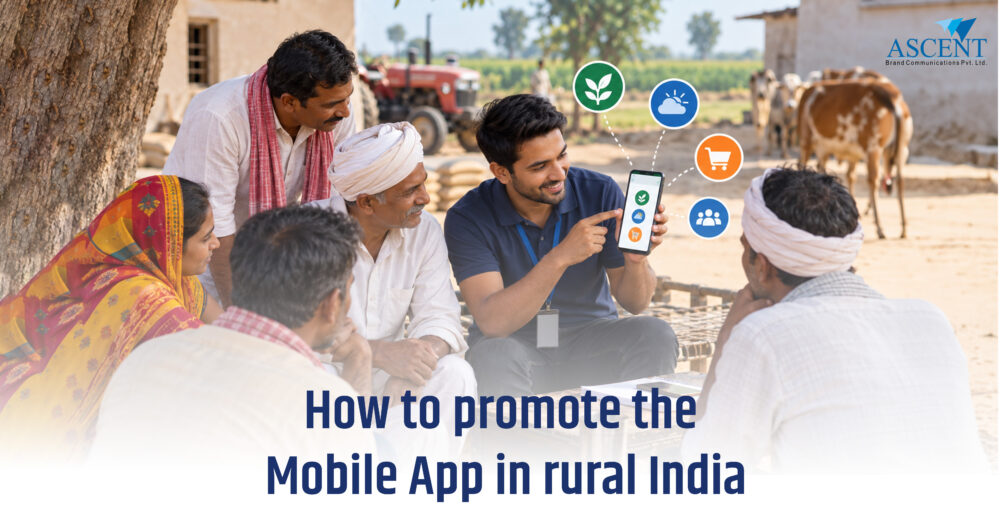
Live demonstrations are one of the most powerful ways to drive rural app adoption. When people see an app solve a real problem in front of them, and someone helps them install and set it up, they are far more likely to use it.
Effective formats include:
- Farmer meets where agronomists show how the app works in the field.
- Rural van campaigns with audio-visual shows and help desks for installation.
- Activations at haats and mandis, where large audiences gather. See Ascent’s article on mandis as an effective touch point to target farmers.
- Assisted installation desks where trained promoters help users download, register and complete their first task in the app.
Assisted installs typically produce more active users than installs driven by ads alone, because users leave already knowing how to use the app. Ascent’s technology-led engagement service supports this approach.
Step 5: Work Through Trusted Local Influencers
Rural users often rely on people they trust when deciding whether to try something new. Engaging these voices can speed up adoption significantly.
Relevant influencers include progressive farmers, agri-input dealers, village retailers, SHG leaders, Common Service Centre operators, gram panchayat members and local youth who are already confident with smartphones. Some apps build networks of paid local champions who help others install and use the app. Ascent’s rural influencer marketing service helps brands identify and manage these partnerships.
A note on public service workers: ASHA workers, Anganwadi workers and other government frontline staff are highly trusted in rural communities, but they work for public programmes. They should only be involved in app promotion through officially approved government or CSR initiatives, and only for apps that serve a clear public benefit, such as health or nutrition information.
Step 6: Use Retailers and Dealers as Install Points
Village shops, agri-input dealers and mobile phone retailers are visited regularly and trusted for advice. Brand visibility at these outlets, with posters, QR codes, simple instructions and, where possible, staff who can help with installation, turns everyday store visits into install opportunities. Retailers can also be motivated through incentives for each active user they bring in. See Ascent’s rural brand visibility service.
Step 7: Reach Rural Users Through Digital Channels
Digital channels extend the reach of on-ground activity and keep the app visible between visits.
- YouTube and short video: regional-language demonstration videos show exactly how the app works. See Ascent’s article on how rural India is consuming YouTube.
- WhatsApp: share short videos, install links and tips in village and farmer groups, and use WhatsApp for support. See Ascent’s WhatsApp marketing service.
- App install campaigns: target ads by district, language and interest on platforms such as Google and Meta.
- App store optimisation: write store listings in Hindi and regional languages, use screenshots that show the app in local contexts, and choose keywords people actually search for, including spoken phrases used in voice search.
For more on combining channels, see Ascent’s article on social media strategies for rural market penetration.
Step 8: Use Referrals and Simple Incentives
Word of mouth is powerful in rural communities. Referral programmes that reward both the existing user and the new user, such as a small cashback, data recharge or discount, can spread an app quickly through family and village networks. Keep rewards simple and easy to claim, and monitor them to prevent misuse.
Step 9: Offer Human Support
Many first-time users need reassurance and help. A toll-free helpline, a missed-call service or an IVR system in local languages makes it easy for users to ask questions and resolve problems. This builds trust and reduces uninstalls. Ascent’s rural call centre service supports this.
Step 10: Build an Integrated Marketing Mix
No single channel is enough. The strongest rural app campaigns combine on-ground activation, such as demonstrations, van campaigns and farmer meets, with retailer visibility, influencer engagement, digital advertising, regional-language video, WhatsApp and, where budgets allow, mass media such as regional TV and radio. Each channel supports the others. Ascent’s integrated rural marketing service brings these elements together.
Step 11: Measure What Matters Beyond Downloads
Downloads alone can be misleading. Track the full user journey:
| Metric | What It Shows |
| Installs by district and channel | Where awareness is turning into action |
| Registration completion rate | Whether onboarding is simple enough |
| First key action | Whether users experience the app’s core value |
| Day 7 and day 30 retention | Whether users keep coming back |
| Uninstall rate | Whether the app is meeting expectations |
| Cost per active user | The true cost of acquiring engaged users |
Use these insights to improve both the app and the campaign. Ascent’s guide on how to measure ROI of a rural marketing campaign explains how to link activity to results.
Ascent’s Experience: Plantix “Mobile Kheti”
For agritech company Plantix, Ascent created a bilingual explainer video introducing its “Mobile Kheti” app and explaining its benefits to farmers in a simple, accessible way. The aim was to help farmers quickly understand what the app does and why it is useful, a critical first step in rural app adoption. You can see more of Ascent’s work with apps in our mobile application case studies and mobile marketing case studies.
Lessons From Apps Built for Rural India
Several apps built for rural users offer useful lessons for marketers:
- Kisan Suvidha, a government app launched in 2016, gives farmers weather forecasts, market prices, crop protection advice and extreme weather alerts in multiple languages. Lesson: practical, everyday information builds habitual use.
- Meri Sadak, launched under the Pradhan Mantri Gram Sadak Yojana, lets citizens report poor rural roads with photos and GPS and track complaints. Lesson: apps that give people a voice and visible results earn trust.
- mDemand, developed by Dhwani Rural Information Systems with the Bhopal-based organisation Samarthan, allowed villagers to register and track requests for household toilets, with geo-tagged photos visible to panchayat and district officials. Lesson: transparency and tracking reduce frustration with delays.
- GoCoop, an online marketplace for cooperatives and community enterprises, helps weavers and artisans sell directly, manage inventory and track orders. Lesson: apps that open new markets and remove middlemen deliver clear value.
- TNAU Cattle Doctor, from Tamil Nadu Agricultural University, provides guidance on feeding, breeding, disease control and calf care for cattle and buffaloes. Lesson: credible, expert-backed content is valued.
- Mooofarm, founded in 2017, uses cattle recognition technology and data to help dairy farmers manage animal health, connect with veterinarians and improve milk quality, and can help reduce insurance fraud. Lesson: combining technology with practical services drives adoption.
- Kisan Raja, by Vinfinite Technologies, lets farmers switch irrigation pumps on and off and check power availability from their phones using a device and voice-based IVR system. Lesson: voice-based solutions work well for users who may not read or type easily.
Frequently Asked Questions
How do you promote a mobile app in rural India?
Start by making the app rural-ready with a small size, local languages, voice support and simple onboarding. Then combine on-ground demonstrations and assisted installs with trusted local influencers, retailer visibility, regional-language YouTube and WhatsApp content, targeted app install ads, referral programmes and human support.
Why do rural users uninstall apps?
Common reasons include limited phone storage, high data use, confusing onboarding, language barriers, lack of trust and not seeing clear value quickly. Addressing these issues improves retention significantly.
Are on-ground activations still needed for app promotion?
Yes. Demonstrations at farmer meets, haats, mandis and van campaigns, combined with assisted installation, often produce more active and loyal users than digital advertising alone.
Which languages should a rural app support?
It depends on the target region. Hindi is essential for many northern and central states, while apps targeting other regions should support languages such as Marathi, Telugu, Tamil, Kannada, Bengali, Gujarati, Punjabi and Odia.
How should rural app campaigns be measured?
Look beyond downloads to registration completion, first key action, retention at 7 and 30 days, uninstall rates and cost per active user.
Conclusion
Rural India offers a large and fast-growing audience for mobile apps, but winning it requires more than advertising. Apps need to be designed for rural realities, introduced through trusted people and places, explained in local languages and supported after installation.
Brands that combine a rural-ready app with thoughtful on-ground engagement, digital reach and careful measurement can build active, loyal user bases in villages and small towns across India.
With more than 25 years of rural marketing experience and expertise in digital and mobile marketing, Ascent helps brands plan and execute app promotion campaigns that drive real adoption. Explore our mobile marketing and strategic rural marketing services.