Rural India is not a smaller, simpler version of the urban market. It has its own media habits, its own pace of decision-making, and its own relationship between a brand and the people it is trying to reach. Planning an advertising campaign for this market the same way you would plan one for a metro city tends to show up in weak results, not because the rural audience is harder to reach, but because it is a different audience with different expectations.
That is really what a Do’s and Don’ts framework is good for here. It will not tell you exactly what your campaign should say or where every rupee should go, but it gives you a set of guardrails that are loose enough to leave room for a genuinely creative campaign, while still catching the mistakes that quietly undermine rural advertising again and again. Here are five of each, drawn from what actually tends to separate a rural campaign that lands from one that does not.
The Do’s: What Successful Rural Campaign Planning Looks Like
Do 1: Pay close attention to what the customer is actually telling you
The starting point of any rural advertising plan is not the creative brief. It is genuinely understanding how the target audience already sees your brand and your category, which is impossible to gauge without direct familiarity with both.
This sounds obvious, but in practice it means listening rather than confirming what you already assumed. A brand entering a new district for the first time should be asking questions, not presenting conclusions, in the early conversations with rural consumers. For example, a seed company assuming farmers primarily care about yield numbers might discover, once it actually listens, that trust in the local dealer matters just as much to the purchase decision. That is the kind of insight you only get by paying attention rather than filling in the blanks yourself.
Do 2: Prioritize, plan, and prepare, in that order
Not every market or region can be tackled with equal intensity at once, and pretending otherwise usually spreads a budget too thin to matter anywhere. Understanding why one market comes before another, based on the brand’s actual strategic objectives, has to happen before campaign planning starts in earnest.
Once priority is clear, planning follows: research on the target audience, and marketing objectives that are ambitious without being disconnected from reality. Only after that should preparation begin, the operational work of getting a campaign ready to run smoothly, with as few surprises as possible once it is live in the field.
Do 3: Mix technology with on-ground presence
Rural India is not offline by default anymore, and treating it that way leaves real reach on the table. At the same time, technology on its own rarely does the job in rural markets the way it might in a metro campaign.
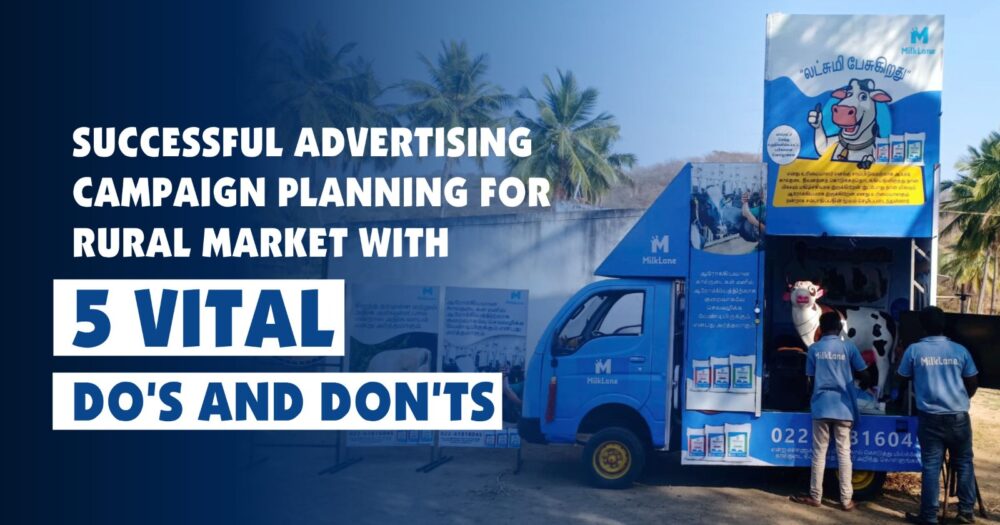
The practical answer is a genuine mix. WhatsApp groups, short local-language video content, and simple mobile follow-up mechanisms like a missed-call number or SMS shortcode can extend the life of an on-ground activation well past the day it happens, without replacing the van campaign, the haat stall, or the retail branding that still does the heavy lifting of first contact in many rural markets. Neither half of that mix should be an afterthought.
Do 4: Keep the client updated in real time, not just at milestones
It is a common pattern for a client to be left in the dark about how a rural campaign is actually progressing, sometimes simply because the agency running it is stretched thin on time or resources in the field. That gap tends to erode confidence faster than almost anything else.
Clients today expect closer to real-time visibility into what is happening, not a summary at the end of a phase. Regular, honest updates, even when the news is “this region is moving slower than expected,” build more trust over the length of an engagement than infrequent, polished reports do.
Do 5: Report results in language the client actually uses
When it is time to show progress, performance indicators should replace marketing jargon, not sit alongside it. Rural campaign ROI is genuinely difficult to calculate cleanly, since so many touchpoints often run at once, but that is exactly why the numbers you do have, sales revenue, response or open rates, closure rates, value per lead, the count of new contacts generated, matter more, not less.
A client who understands what happened is a client who trusts what happens next. This is also where measurement planning earns its place early rather than late; see the section below on making measurement practical.
Making Measurement Practical
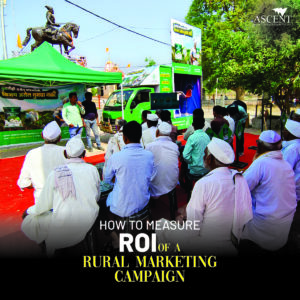
Because rural campaigns often combine several touchpoints, on-ground activation, local media, retail branding, and increasingly some digital follow-up, attribution is rarely as clean as a single-channel digital campaign. That is a real constraint, not a reason to avoid measurement altogether.
What tends to work is agreeing on a small set of metrics before the campaign starts, not after: reach into target villages or towns, engagement at activation points such as demonstrations or sampling, leads or enquiries generated and where they came from when that can be tracked, dealer or retailer feedback on footfall and interest, and where a specific mechanism like a coupon code or missed-call number exists, the conversions tied directly to it. Sales growth in a region is worth watching, but attributing it entirely to a single campaign element, when several were running simultaneously, is rarely a defensible claim on its own.
The Don’ts: Where Rural Campaigns Tend to Go Wrong
Don’t 1: Assume the rural audience is simple
There is a persistent idea that rural and small-town consumers are straightforward to predict, want less, and think less about a purchase. That assumption may have held some truth decades ago. It does not hold up against how genuinely varied and considered rural consumer behavior actually is today.
A rural marketing plan built on this assumption tends to underestimate the audience in ways that show up as tone-deaf messaging or oversimplified offers. Understanding what the target market actually wants, rather than what it is assumed to want, remains the real foundation of a rural campaign that works.
Don’t 2: Assume rural and urban markets have merged
The opposite mistake is just as common: assuming the gap between rural and urban markets has essentially closed, so a campaign built for a metro audience can simply be extended into rural areas with minor tweaks. It may be true that the two markets continue to converge over time. In the near term, treating them as interchangeable tends to make a rural campaign fall flat, since the media habits, language expectations, and trust dynamics still differ meaningfully.
Don’t 3: Override the client’s input
It is true that a client is usually less familiar with the specific tactics and current trends of rural marketing than the agency running the campaign. That does not make their input less valuable. They built the product, and they understand its category and its customers in ways an outside team has to work to learn. Their perspective should be weighed seriously, not treated as a formality to be worked around.
Don’t 4: Underestimate the importance of content quality
One of the most common mistakes in rural marketing is treating content as an afterthought, something to fill space around the media plan rather than a real driver of how a campaign performs. Content quality in rural marketing goes beyond whether something looks polished online. It includes whether a wall painting is legible from the road, whether a folk performance script actually lands with local humor, and whether a demonstration video explains the product clearly in the local language. Underinvesting here shows up directly in how well a campaign is remembered.
Don’t 5: Swing too far on either side of the budget
Overspending is the more obvious mistake, but underfunding a campaign to the point where quality suffers causes just as much damage, often more, since a weak campaign can actively hurt brand perception rather than simply underdelivering. The right approach is genuine discipline on spending without letting that discipline compromise the work itself. Those are not the same thing, and treating them as interchangeable is where budget decisions go wrong.
Bringing the Do’s and Don’ts Together
None of these ten points works in isolation. A campaign can nail the media mix and still fail if the client feels shut out of the process, or get the budget exactly right and still underperform because the audience was misjudged from the start. Treat this as a checklist to review together before a rural campaign goes live, not as ten separate boxes to tick individually.
If you are planning an advertising campaign for rural or semi-urban markets, Ascent can help you build a strategy that connects consumer insight, communication, media, and on-ground execution. Get in touch with Ascent to talk through what you are trying to achieve.
Frequently Asked Questions
What makes rural advertising different from urban advertising?
Rural advertising has to account for different media habits, language expectations, and a slower, more relationship-based path to trust. A campaign built for urban audiences and simply extended into rural markets usually underperforms, since the two audiences do not respond to the same cues.
How do you plan an advertising campaign for rural markets?
Start with genuine audience understanding through rural market research, prioritize which markets matter most for your objectives, build a realistic plan and timeline, and only then move into execution and preparation.
Which media work best for rural advertising?
There is rarely a single answer. Most effective rural campaigns combine on-ground activation, such as van campaigns or haat and mela presence, with local media and increasingly some mobile follow-up like WhatsApp or SMS, rather than relying on any one channel alone.
Why is local language important in rural advertising?
Language carries more than translation. Local expressions, humor, and cultural references signal that a brand actually understands its audience, rather than having adapted a message built for somewhere else.
What are common mistakes in rural advertising?
The most frequent ones include assuming rural consumers are simple to predict, underinvesting in content quality, sidelining client input, and getting the budget wrong in either direction, spending too much without discipline or too little to maintain quality.
How can brands measure rural advertising campaign success?
Through a combination of reach, engagement at activation points, trackable leads or enquiries, and retailer or dealer feedback, agreed on before the campaign starts. Attribution across multiple simultaneous touchpoints is genuinely difficult, so results should be interpreted with that limitation in mind rather than overclaimed.