Brand Recall
Brand recall is a measure of how strongly a brand name is connected to a specific product category in the minds of customers. In practical terms, it is a customer’s ability to identify a brand the moment a certain product type comes up in conversation. For example, when someone thinks of instant noodles, the name Maggi often comes to mind immediately, even before the generic product term does.
Brand Visibility
Brand visibility refers to how consistently and prominently a brand appears in front of its customers. It is one of the most effective ways to build brand awareness over time. With these definitions in place, we can look at how brand visibility and strong brand recall are connected, particularly in rural markets.
Why Brand Visibility Matters
In rural areas, brand visibility is not a standalone activity. It is the result of every marketing effort a company puts into building awareness, from advertising and promotions to public relations and on-ground presence. Visibility on its own is not enough. A brand needs to be seen in the right context and the right light for that visibility to create a meaningful impact.
The basic logic here is simple: a customer cannot choose a brand they do not know exists. This is why brand awareness is often treated as the starting point of any rural marketing strategy, and why visibility efforts need to be sustained rather than one-off.
Beyond building awareness, strong visibility also supports the company’s broader marketing strategy by making every other campaign, product launch, or promotion more effective, since the audience already recognizes the brand.
Connecting Visibility to Recall
Brand recall depends heavily on how a brand is built and how customers experience it over time. It is often said that profits come from products, but brands are built on emotion. Evoking the right emotional response in an audience is central to shaping how that audience perceives the brand.
When a brand consistently earns the right attention and emotional connection, it starts to feel like a part of the customer’s daily life rather than just another product on a shelf. At that point, customers begin to recall the brand itself rather than the generic product category. This is known as unaided recall, and it is what allows a brand to stand out clearly in a crowded market.
Where the Process Begins
To reach strong brand recall, brand visibility has to come first. The idea that “the more you see, the more you remember” holds up well in marketing, and research consistently shows that people retain a meaningful share of what they are repeatedly exposed to visually.
A clear example of this is Coca-Cola and Pepsi. Both brands are so closely tied to the category of carbonated soft drinks that many people describe the category using the brand names themselves, rather than a generic term. That level of recall is the direct result of decades of consistent visibility.
Why This Matters More in Rural Markets
Many brands have historically underinvested in rural markets, which means the level of brand recall that exists in urban India often does not carry over automatically. Building that recall in rural markets requires a deliberate visibility strategy, not an assumption that awareness will happen on its own.
Given how trust is built in these markets, consistent visibility plays a direct role in strengthening a company’s reputation and giving it a real competitive edge over less visible competitors. The more frequently a brand appears in a customer’s environment, whether through retail presence, local activations, or community engagement, the more that customer begins to trust it. That trust is what eventually translates into recall, preference, and repeat purchase behavior.
An Ascent Group India Case Study: Building Visibility on the Ground
At Ascent Group India, rural brand visibility is not treated as a byproduct of broader campaigns. It is planned and executed as its own discipline, built around how rural audiences actually consume information and build trust.
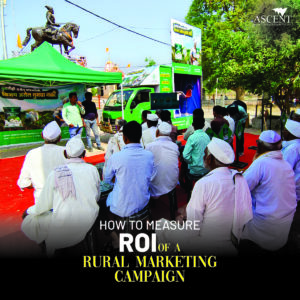
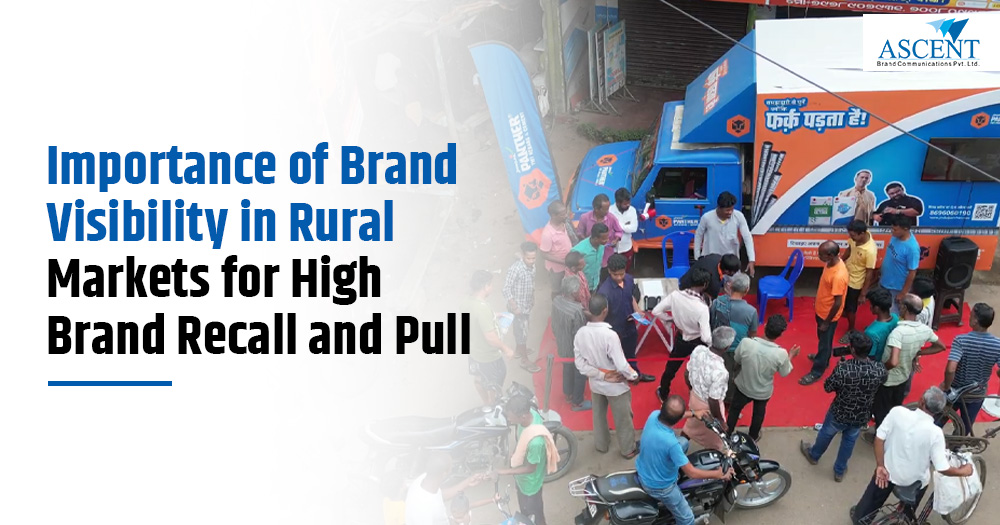
For one of our FMCG clients entering new rural markets across central India, we designed a visibility-first campaign that combined haat and mela activations, wall paintings and signage in high-footfall village locations, retail branding at local kirana stores, and van-based promotional campaigns covering multiple villages within each district. Rather than a single large push, the campaign was structured as sustained, repeated exposure across a defined market over several months.
The results reflected exactly the pattern described above. Unaided brand recall in the target villages rose substantially within the campaign period, retail partners reported increased customer requests for the brand by name rather than by product category, and the client saw measurable improvement in sell-through at the retail points we had branded. The visibility effort did not just build awareness. It created the kind of trust that directly influenced purchase decisions on the ground.
This is the core principle behind rural marketing at Ascent: visibility has to be consistent, contextually relevant, and sustained long enough for recall to take hold. A single activation rarely moves the needle. Repeated, well-placed presence does.
Conclusion
Brand visibility and brand recall are closely linked, and nowhere is this more evident than in rural markets, where trust is built through consistent, on-ground presence rather than one-off campaigns. Companies that treat visibility as an ongoing strategy, not a single event, are the ones that end up owning recall in their category.
If you are looking to build genuine brand recall in rural India, Ascent Group India can help design a visibility strategy grounded in how these markets actually work. Get in touch to discuss what that could look like for your brand.