
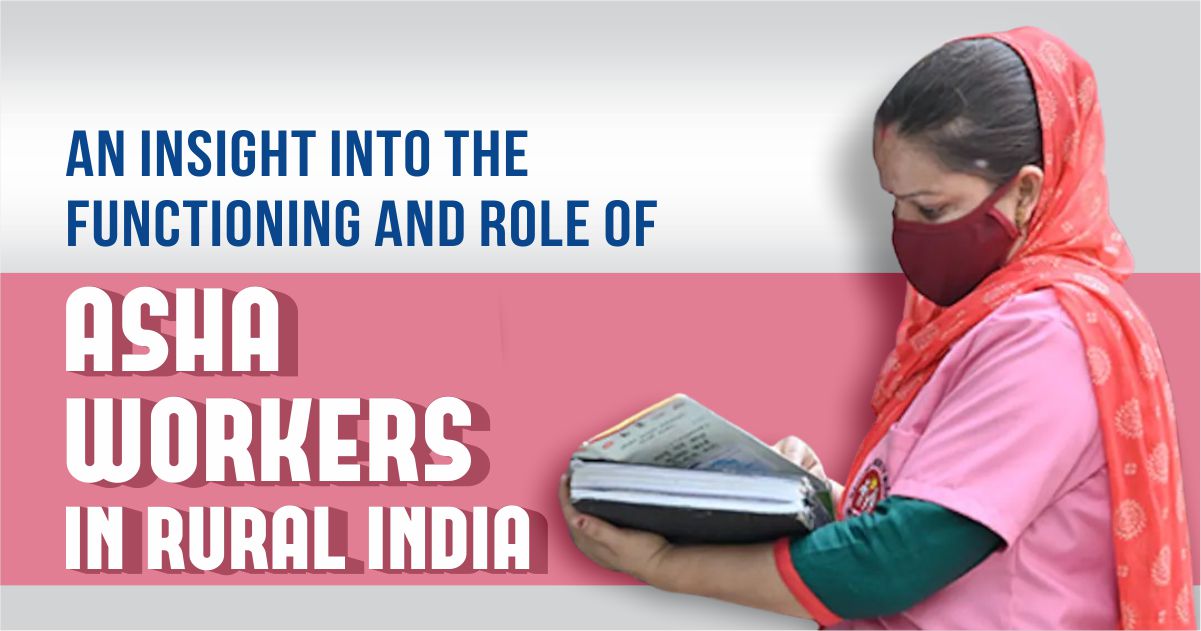
A trained female community health worker is an Accredited Social Health Activist, known as an ASHA. Chosen from within the community and accountable to it, an ASHA is trained to serve as a link between her village and the public health system.
The ASHA program remains one of the largest community health worker initiatives in the world. Nationally, approximately 9.2 lakh ASHAs serve rural India, with close to 80,000 more working in urban areas, and the program operates across the vast majority of India’s states and union territories. The role of an ASHA is that of a community-level care provider with a variety of responsibilities, including:
- Facilitating access to health care services
- Raising awareness about health care entitlements, particularly among the poor and marginalized
- Promoting healthy behaviors and mobilizing collective action for better health outcomes
- Meeting curative care needs appropriate to her training, experience, and the way services are organized in her area
To understand the current scenario, functions, and role of ASHA workers, Ascent conducted an original field survey of 100 ASHA workers across the states of India. What follows presents that research alongside updated national context.
Who Are ASHA Workers?
ASHA workers were introduced under India’s National Rural Health Mission in 2005, with the aim of placing a trained community health volunteer in every village. They are not classified as government employees; instead, they work on a largely honorary basis, compensated through a combination of a fixed government incentive and performance-based payments tied to specific health activities.
Methodology
Ascent conducted a primary survey to gather responses directly from ASHA workers for effective data collection. The research and results were processed using MS Excel and SPSS and are presented below by theme.
Key Responsibilities of ASHA Workers
Education Qualification
Most of the ASHA workers in Ascent’s survey sample had completed 10th and 12th class education, with a smaller number of graduates. This was followed by volunteers with 6th and 7th class education. This baseline of primary education helps ASHA workers understand the health information associated with the products and services they promote and support.
Work Experience
Most surveyed workers had 5 to 10 years of experience, followed by those with 10 to 15 years. The smallest group had 0 to 5 years of experience, indicating a workforce with substantial tenure and field knowledge.
Working Hours
Most surveyed workers worked 7 to 8 hours a day, while a smaller number worked 5 to 6 hours. Working hours varied depending on the distance covered and the population of the area served.
ASHA Workers and Maternal and Child Health
ASHA workers play a central role in maternal and child health, including antenatal counseling, encouraging institutional deliveries, supporting breastfeeding and child nutrition guidance, and following up on child immunization. National program data for the 2024-25 financial year shows the scale of this work: over 71 lakh scheduled newborn visits were completed by ASHAs between April and September 2024 alone, with more than 5 lakh newborns identified as requiring further care during those visits.
ASHA Workers and Community Healthcare
Major Duties During Ascent’s 2022 Survey Period
At the time of Ascent’s original survey, the largest share of surveyed ASHA workers were engaged in COVID-19 vaccination drive work, with roughly equal proportions also working on COVID patient support, general health problems, and maternity-related issues. This reflected the immediate demands of the pandemic response period, when COVID-related activity understandably dominated ASHA workloads across the country.
Communication and Interaction with Villagers
The survey found that door-to-door visits were the most common way ASHA workers communicated with villagers, followed by calling meetings in common village areas and organizing camps.
Use of Smartphones
In Ascent’s survey, 58 percent of participants reported using smartphones in their daily life, with some receiving devices through government schemes. Of those using smartphones, WhatsApp was the clear preference for professional and personal use, followed by Facebook and YouTube. Since this survey was conducted, rural smartphone and internet access in India has continued to expand, which is likely to have increased digital tool use among ASHA workers further, though this specific figure has not been re-surveyed and should be treated as a 2022 snapshot rather than a current statistic.
Villagers’ Dependence and Trust
A large majority of the population in the surveyed areas trusts ASHA workers to help resolve health-related issues. A smaller group, generally those who have started traveling to nearby towns, depends more on hospital staff and other health care workers.
Appreciation for Their Efforts
Eighty percent of the ASHA workers surveyed said they receive appreciation and accolades for their work, while the remainder felt their contribution goes unrecognized, though none reported active criticism of their role.
Compensation and Incentives
Monthly Income (Ascent’s 2022 Survey Findings)
Among the ASHA workers surveyed, the largest group reported monthly earnings of Rs 2,500 to Rs 3,000, with a smaller share reporting Rs 3,000 to Rs 3,500. A minimum of Rs 2,000 was noted as fixed regardless of other factors, consistent with the central government’s incentive structure.
This central government incentive of Rs 2,000 per month for routine and recurring activities remains in place today. What has changed since 2022 is that a growing number of state governments now add substantial top-ups on top of this base amount. As of early 2025, Andhra Pradesh pays ASHA workers a fixed Rs 10,000 per month, Kerala raised its state honorarium to Rs 7,000, Telangana pays a Rs 6,750 top-up, and Madhya Pradesh pays a Rs 4,000 top-up, with several other states adding smaller amounts. This means ASHA compensation today varies considerably depending on where a worker is based, in a way that was less pronounced in 2022.
Engagement with Different Organizations
A significant proportion of the ASHA workers surveyed were not connected to any community resource program run by a company, while a smaller share were. Public health centers generally provide free health and pharmaceutical products, which limits the budget available for private engagement. Companies operating in categories such as sanitary napkins, contraceptives, condoms, and health and nutrition supplements were the most likely to work with ASHA workers to promote affordable local products in rural areas. Some ASHA workers also take on survey-related work for NGOs and research projects run by public and private organizations, with incentives varying by the nature and duration of the work.
Job Satisfaction
Around 74 percent of the ASHA workers surveyed said they genuinely value the work they do, seeing it as a contribution to a good cause. The remaining 26 percent said they had no other employment option available to them. This suggests that while most ASHA workers find meaning in the role, economic necessity remains a significant factor in why some take it on.
How the Role of ASHA Workers Has Evolved
Since Ascent’s original survey, the ASHA program’s scope has continued to broaden beyond the pandemic-era focus captured in the 2022 findings. Notably, the government extended Ayushman Bharat PM-JAY health cover, India’s flagship public health insurance scheme, to ASHA workers, Anganwadi workers, and Anganwadi helpers starting in February 2024, covering an estimated 37 lakh workers and their families. ASHA workers’ pandemic-era contribution was also formally recognized: the World Health Organization named community health workers, including India’s ASHAs, among its Global Health Leaders in 2022 for their role in the COVID-19 response.
Today, ASHA responsibilities span routine immunization support, maternal and newborn home visits, tuberculosis case tracking under the government’s TB-elimination program, non-communicable disease screening, and community mobilization for programs delivered through Ayushman Arogya Mandirs, the health and wellness centers that form the backbone of India’s primary care network. COVID-19 remains part of the program’s history and a significant chapter in how ASHA workers proved their value to India’s health system, but it is now one part of a broader, ongoing mandate rather than the program’s defining focus.
Why ASHA Workers Matter to Rural India
ASHA workers remain one of the most trusted points of contact between rural India and the formal health system. Ascent’s survey findings on villager trust reflect a broader pattern documented in national and state-level research: because ASHA workers are chosen from within their own communities, they carry a level of local credibility that outside health workers often take years to build. This same dynamic of community-rooted trust is directly relevant to how brands and organizations think about rural engagement more broadly, whether in health, agriculture, or consumer categories, which is why understanding the ASHA model offers useful lessons for anyone planning rural community outreach in India.
Conclusion
ASHA workers play an essential role in the health sector of rural India, keeping a close watch on villagers’ health needs and providing direct help and solutions. The government supports ASHA workers through a combination of fixed and performance-based incentives to compensate for work that remains largely voluntary in structure. Ascent’s original survey found clear evidence that rural communities trust and depend on ASHA workers for health and family welfare matters, a finding that continues to hold true as the role has expanded well beyond its pandemic-era focus. This same foundation of local trust is one of the reasons ASHA workers can also play a meaningful part in how brands think about rural marketing in India.
Frequently Asked Questions
What is the role of ASHA workers in rural India?
ASHA workers act as a link between rural communities and India’s public health system, facilitating access to health services, raising health awareness, promoting healthy behaviors, and providing basic curative care within the scope of their training.
Who are ASHA workers?
ASHA stands for Accredited Social Health Activist. ASHA workers are trained female community health volunteers, selected from and accountable to their own village or community, under India’s National Health Mission.
What are the main responsibilities of ASHA workers?
Their core responsibilities include maternal and child health support, immunization mobilization, health awareness campaigns, basic curative care and referrals, and increasingly, participation in national programs covering tuberculosis, non-communicable diseases, and community health screening.
Why are ASHA workers important in rural India?
They are often the first and most trusted point of contact for health services in rural communities, particularly for households that would otherwise struggle to access formal health infrastructure.
What challenges do ASHA workers face?
Compensation remains a significant challenge, since ASHA workers are not classified as formal government employees and rely on a mix of a fixed central incentive and performance-based payments that vary considerably by state.
How do ASHA workers support maternal and child health?
They conduct antenatal counseling, encourage institutional deliveries, support breastfeeding and child nutrition guidance, and carry out scheduled home visits to newborns and young children, work that continues at significant scale nationally.
Are ASHA workers government employees?
No. ASHA workers are considered honorary community volunteers rather than formal government employees, which is a central and ongoing point of debate around their compensation and benefits.