Rural India is not the marketing afterthought it used to be treated as. It is the larger half of the country by population, it is where FMCG, agri-input, and financial services brands increasingly find their next real growth, and it now behaves differently than it did even a few years ago: incomes are rising, formal credit access is expanding, and mobile-first digital habits are spreading fast. Brands that still market to rural India with a scaled-down version of their urban playbook are leaving growth on the table.
This guide sets out the current data on rural India, how rural consumer behavior actually works, and the digital and distribution strategies that are working right now, with real, named examples rather than generic advice.
Key Statistics
- 84% of India’s population was classified as rural in the 2011 Census, the most recent completed Census (India’s 2021 Census was postponed and has not yet been conducted).
- A more recent World Bank estimate puts India’s rural population at 13% as of 2024, suggesting a gradual decline in the rural share of the population even as its absolute size continues to grow.
- Rural retail sales were projected to reach approximately $100 billion by 2025 in industry estimates made before that year; whether that figure has been confirmed by current market data is worth checking against the latest available report before quoting it in client-facing material.
- In 2024, rural consumption growth outpaced urban consumption for the first time in five quarters, with rural growth reported at 6% against 5.7% in urban areas.
- NABARD’s Rural Economic Conditions and Sentiments Survey, released in December 2025, found that 2% of rural households reported income growth, the strongest result recorded across all rounds of the survey, and that formal credit access had reached 58.3% of rural households, up from 48.7% roughly a year earlier.
- Over 70% of rural sales are made to the rural middle class, a segment that is becoming more discerning about quality and brand preference rather than buying on price alone.
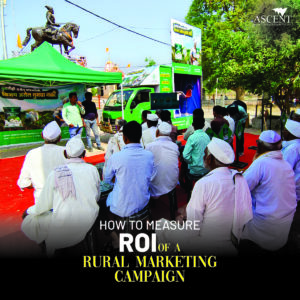
Together, these numbers point to the same conclusion: rural India is a large market that is also actively changing, which means strategies built on five-year-old assumptions about rural consumers are increasingly out of step with how that market behaves today. For a closer look at how to translate these numbers into a campaign budget, see how to measure the ROI of a rural marketing campaign.
Rural India Consumer Insights
| Category | Insight |
| Population in rural India | 68.84% of the total population (Census of India, 2011); a more recent World Bank estimate puts this at 63.13% as of 2024 |
| Mobile penetration | 52.4% internet access via smartphones, as reported by Kantar IMRB |
| Average income | Approximately ₹1,22,616 per annum per household, per National Statistical Office data |
| Preferred payment method | Cash remains dominant, though formal credit and digital payment adoption are both rising, per NABARD’s December 2025 survey |
| Effective marketing channels | WhatsApp, SMS, and local influencers |
| Key industries | FMCG, telecom, agriculture, and banking |
Analyzing Rural Consumer Behaviour
Cultural Nuances and Their Impact
Rural consumers in India are deeply rooted in local traditions and customs, and that shapes purchasing decisions in ways urban-first campaigns often miss. A few patterns matter most:
- Language and dialect. India is home to well over a thousand dialects, and campaigns built in the local language of a region consistently see higher acceptance than translated or Hindi-only content.
- Cultural festivals. Brands that align campaigns with regional festivals, such as Pongal in Tamil Nadu or Baisakhi in Punjab, tend to see stronger engagement than brands running a single national campaign calendar.
- Family-centric buying decisions. In rural households, purchasing decisions are frequently made by the whole family rather than one individual, which means messaging needs to speak to shared, not just individual, values.
- Brand loyalty. Rural consumers often show strong loyalty to brands that consistently reflect their cultural values and deliver on quality, more so than price alone.
- Media influence. With television and mobile phones now widespread, rural consumers are considerably more brand-aware than in the past, and increasingly look for products that reflect their identity, not just meet a functional need.
Assessing Purchasing Power and Affordability
Rural incomes remain lower on average than urban incomes, but that does not mean rural consumers are simply price-driven. A few things matter for positioning:
- Household income. National Statistical Office data puts average rural household income at approximately ₹1,22,616 per annum.
- Affordable product formats. Smaller pack sizes for everyday items like shampoo or detergent remain a strong entry point for new categories in rural markets.
- Cash still leads, but that is changing. Cash remains the dominant transaction method, though NABARD’s most recent survey shows formal credit access rising quickly, which typically precedes broader digital payment adoption.
Digital Strategies for Rural Engagement
Mobile Marketing
Mobile is now the primary way most rural consumers access information and brands, which makes a mobile-first approach non-negotiable rather than optional:
- WhatsApp marketing. With several hundred million users in India, WhatsApp remains one of the most effective direct channels for reaching rural audiences with messages, images, and video in the local language. See WhatsApp marketing for rural India for a deeper look at how to run this well.
- SMS marketing. In areas with limited internet access, SMS still delivers reliable reach; short, action-oriented messages continue to outperform long, generic ones.
- Interactive voice response (IVR). In regions with lower literacy rates, IVR delivers audio-based marketing messages in the local language, extending reach and comprehension beyond what text-based channels can achieve alone.
Localized Content
Generic, translated content is one of the most common and avoidable reasons rural campaigns underperform:
- Multilingual content, created natively. Content built directly in the target region’s language, by people who understand that region, consistently outperforms content translated from an English or Hindi master.
- Visual storytelling. Video and infographics travel further with rural audiences than dense text, particularly where literacy levels vary.
- Local influencers. Rural consumers frequently turn to local influencers and community leaders for purchasing advice, which makes regional brand ambassadors a genuine credibility asset, not just a reach tactic.
One clear example of localized content done well: agricultural input company NETAFIM ran its “Krishi Samvaad” programme, engaging farmers through Facebook Live sessions built around specific crops and regions rather than a single generic campaign, a model of localization built around what farmers actually needed to know, not just where they could be reached.
Innovative Distribution Models
Micro-distribution Centres
Last-mile distribution remains one of the hardest problems in rural marketing, and it is often the real bottleneck behind an otherwise sound campaign:
- Micro-distribution centres allow smaller stock quantities to be held closer to rural demand, keeping products consistently available instead of relying on long, infrequent supply runs.
- Decentralised distribution meaningfully reduces the logistics cost of reaching remote areas compared with a single centralised warehouse model.
- These centres can also create local livelihoods, which builds goodwill alongside commercial reach.
Hindustan Unilever’s Project Shakti remains one of the clearest examples of this model in practice: a network of local women acting as micro-distributors, taking products directly into villages that traditional retail supply chains struggle to reach efficiently.
Local Partnerships
Rural India runs on community-based commerce, and partnering into that system tends to outperform trying to build a parallel one:
- Kirana stores. Local retail outlets already function as trusted sources for rural consumers, and partnering with them gives a brand an instant, credible distribution network.
- Self-help groups (SHGs). In many regions, SHGs function as genuine distribution nodes; Dabur’s partnerships with SHGs are a well-known example of building a sustainable rural distribution model this way.
- Rural entrepreneurship. Amul’s dairy cooperative model shows how enabling local entrepreneurs, rather than bypassing them, can deepen market reach while also supporting the community a brand is trying to sell into.
Conclusion
Rural India is no longer an unfamiliar or hard-to-read market. With rising mobile access, expanding formal credit, and a rural middle class that is becoming more discerning, the brands that will win here are the ones treating rural strategy as its own discipline, not a scaled-down version of an urban campaign.
Key Takeaways
- Understand the local culture first. Campaigns built around regional customs and language consistently outperform generic, translated ones.
- Do not assume price is everything. Affordability matters, but quality, trust, and brand identity increasingly drive rural purchasing decisions too.
- Lead with mobile. WhatsApp, SMS, and increasingly video are the channels rural consumers actually use.
- Solve distribution, not just messaging. Micro-distribution and local partnerships often matter as much as the creative itself.
If you are shaping a rural go-to-market plan and want a partner who can execute this on the ground, not just advise on it, here is how to choose the right rural marketing agency, or you can go straight to Ascent’s rural marketing services to talk through your specific markets.
FAQs
What is rural marketing and why does it matter? Rural marketing is the practice of promoting products and services specifically to rural and semi-urban audiences, using strategies adapted to local language, culture, income levels, and distribution realities. It matters because rural India represents the larger share of the country’s population and an increasingly important source of consumption growth.
What are the key features of rural marketing? Rural marketing is defined by localized language and messaging, distribution built for last-mile reach rather than dense retail networks, pricing and pack sizes adapted to rural income patterns, and channels like WhatsApp, SMS, and local influencers that outperform generic mass media.
How does rural marketing differ from urban marketing? Rural marketing depends more heavily on trust-based, community-driven channels (kirana stores, local influencers, self-help groups) and less on paid urban media. Purchasing decisions are more often family-based, and distribution logistics, not just creative messaging, frequently determine campaign success.
What are the biggest challenges in rural marketing? The most common challenges are last-mile distribution, inconsistent internet access in some regions, the need for genuinely localized (not translated) content, and measuring campaign impact accurately across dispersed, offline-heavy markets.
What are effective rural marketing strategies for FMCG products specifically? FMCG brands typically succeed in rural India through smaller, more affordable pack sizes, strong kirana and SHG distribution partnerships, and vernacular, mobile-first marketing. For a deeper look at this, see rural marketing in the FMCG sector.
Is WhatsApp really an effective rural marketing channel? Yes. With several hundred million users across India and strong penetration even in lower-connectivity regions, WhatsApp is currently one of the most effective direct channels for rural engagement, particularly for local-language messaging, images, and short video.
How important is distribution compared to advertising in rural marketing? Often just as important, sometimes more so. A well-targeted campaign can still fail if the product is not reliably available nearby; micro-distribution centres and local retail or SHG partnerships frequently determine whether rural marketing investment converts into actual sales.