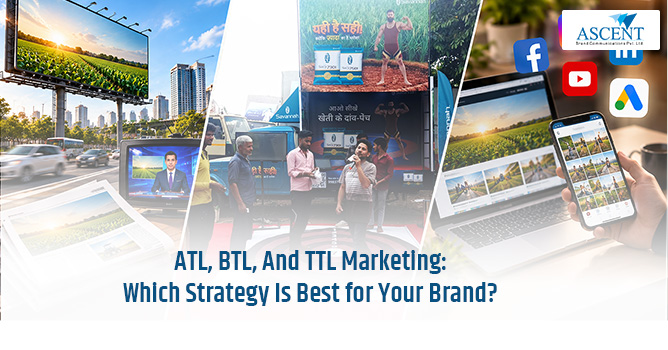
Choosing the right marketing approach starts with understanding the options available. This article breaks down ATL, BTL, and TTL marketing strategies in plain language, so you can decide which combination fits your brand’s goals, budget, and audience.
Defining the Marketing Strategies
Marketing strategies shape how a brand reaches its audience. There are three core approaches worth understanding: Above The Line, Below The Line, and Through The Line marketing.
Above The Line (ATL)
ATL uses mass media such as television, radio, and billboards to spread a brand’s message. It is a broad, largely untargeted approach designed to reach many people at once, with the primary goal of building brand awareness and goodwill among large audiences.
For rural Indian markets, ATL can be highly effective, since it helps a brand become known to a wide population quickly. The trade-off is precision. Because the message is not targeted, it will not always resonate with every viewer. Even so, ATL remains one of the most reliable ways to make a strong first impression and get noticed across rural India.
Below The Line (BTL)
While ATL casts a wide net, BTL takes a more focused approach. Below The Line marketing targets specific groups of people through direct engagement methods. BTL is widely used for rural campaigns across India and has consistently delivered strong results across a range of industries. It tends to work particularly well for connecting with local communities on their own terms.
Through The Line (TTL)
Through The Line marketing blends the strengths of ATL and BTL into a single strategy. It is designed to reach both broad and specific audiences at once, and it has produced strong outcomes in rural India when executed well.
A typical TTL campaign might combine television advertising with local events and social media activity, helping a brand connect with people in villages and small towns on multiple levels. The goal extends beyond a single sale. It is about building trust and sustained awareness over time.
TTL works particularly well in rural markets because of its flexibility. A brand can use mass media to spread a message broadly, then follow up with personalized outreach. A radio jingle followed by targeted SMS offers is a simple example of this layered approach, and this kind of combination helps a brand stand out in a crowded market.
Advantages of ATL Marketing
ATL marketing offers wide reach and builds strong brand awareness through mass media channels.
Broad Audience Reach
ATL marketing reaches a large audience through television, radio, and print. A single television advertisement can reach millions of rural households in one broadcast, which makes ATL especially effective for new product launches or reinforcing an existing brand. This broad reach also sets the stage for more targeted follow-up efforts.
Enhances Brand Visibility
Building on its broad reach, ATL marketing strengthens brand visibility. This matters for firms targeting rural Indian markets, since consistent visibility helps a brand become more familiar and trusted over time.
Roadside signage and advertising placed during popular television programming can capture attention efficiently, helping a brand become a familiar presence in rural households. Over time, this consistency supports stronger trust and measurable sales growth.
Disadvantages of ATL Marketing
ATL marketing comes with real challenges, starting with cost.
High Costs
ATL campaigns carry a significant price tag. Television and print advertising can run into the lakhs of rupees, which puts this channel out of reach for many smaller businesses. Typically, only larger companies can sustain big-budget ATL promotions consistently.
For brands working with tighter budgets, digital and BTL alternatives often deliver better value, since they allow more direct and cost-efficient engagement with a defined target group.
Difficult to Measure Direct Impact
ATL marketing also makes it harder to measure direct impact. Linking a specific sale or lead back to a particular television advertisement or billboard is difficult, which complicates return on investment calculations and can make ATL spending harder to justify with hard data.
Advantages of BTL Marketing
BTL marketing creates a direct line to the target audience, allowing personal engagement through tactics such as targeted messaging and community-level activity.
Targeted Audience Engagement
BTL strategies aimed at rural Indian markets typically rely on direct messaging, van campaigns, sponsorships, and in-store promotions to reach specific groups. These methods support precise audience contact, which tends to produce higher conversion rates and stronger personal connections.
Campaigns that speak directly to rural customers’ needs, habits, and language tend to build trust and loyalty more effectively. This makes BTL a cost-effective way to grow a customer base steadily rather than relying solely on scale.
BTL marketing also stands out for its cost-effectiveness in rural India. Low-cost, high-impact tactics such as local events or SMS outreach can deliver strong results relative to spend. Digital channels such as email marketing carry minimal sending costs while producing measurable, trackable results through analytics.
Combining digital and on-ground efforts, and tracking engagement directly, allows brands to measure return on investment with much greater clarity than broad-reach advertising typically allows.
Disadvantages of BTL Marketing
BTL marketing has its own limitations, particularly around scale and planning time.
Limited Reach
BTL marketing cannot match the scale of ATL methods. While it targets specific groups effectively, fewer people see the brand overall, which can slow broader growth. This is a genuine trade-off that needs to be weighed against the benefits of precision targeting.
BTL tactics tend to perform well for short-term goals but can fall short for long-term brand building on their own. In markets where word-of-mouth carries significant weight, limited reach can become a real constraint, which is why BTL is often paired with broader strategies rather than used in isolation.
Time-Consuming Execution
BTL marketing also demands more planning time. Personalized campaigns require careful design and skilled execution at every stage, from concept to rollout, which can extend timelines and require more resources upfront.
That said, the additional planning time often pays off. The personal touch that BTL enables tends to build deeper trust and loyalty than broader, faster campaigns, which can be well worth the extra investment for brands focused on long-term relationships.
Advantages of TTL Marketing
TTL marketing combines the strengths of ATL and BTL into a more complete approach, reaching wide audiences while still targeting specific groups.
Integrated Approach
TTL blends mass-market advertising with targeted promotions to cover the full customer journey. This combination allows a brand to reach rural Indian markets through multiple channels at once, using both large-scale media and personal engagement to create a more complete brand experience.
This integrated approach also supports better measurement, since each part of the campaign can be tracked across different platforms, making it easier to refine tactics and improve return on investment over time.
Flexibility in Use
TTL marketing offers strong flexibility, allowing methods to be mixed and adjusted based on what performs best in a given rural market. A campaign might begin with television advertising to build broad awareness, then follow with local events in villages to deepen the connection. This layered approach helps a message land in multiple ways across a diverse audience.
Disadvantages of TTL Marketing
TTL marketing can be difficult to manage well, since it requires blending different types of campaigns into one coherent strategy.
Complex Coordination
TTL marketing requires careful planning to ensure that all channels work together effectively, which becomes even more demanding when targeting diverse rural markets. Coordinating television, radio, and local events consistently, while keeping messaging aligned across very different regions, is a genuinely complex task. Brands that underestimate this complexity often end up with inconsistent messaging that confuses their audience.
Requires High Skill Levels
TTL marketing depends on a skilled team capable of interpreting data and running structured tests across channels. Rural markets in particular benefit from a mix of traditional and modern tactics, which takes time to develop and refine. It is a demanding approach, but one that delivers strong results when executed well.
Choosing the Right Strategy for Your Brand
Selecting the right marketing approach requires weighing several factors specific to your brand and audience.
- Market Understanding: Know your rural audience well, since their habits, preferences, and needs often differ meaningfully from urban markets. Local festivals and events frequently present strong opportunities for brand activation.
- Budget Constraints: Rural marketing often requires more investment than expected. Plan for both above-the-line and below-the-line efforts rather than committing to only one.
- Reach vs. Impact: Decide whether the priority is reaching many people or making a deeper impact on a smaller group. Television can reach millions, while direct marketing tends to build stronger individual connections.
- Language and Culture: Use appropriate local language and respect regional cultural norms. Campaigns that reflect local dialects and customs consistently perform better.
- Infrastructure Limits: Account for constraints such as poor roads, limited electricity, or weak internet connectivity, all of which affect how a message can be delivered. Mobile vans are often a practical solution in areas with difficult road access.
- Literacy Rates: In areas with lower literacy, visual advertising and radio tend to outperform print.
- Digital Readiness: Assess local smartphone and internet usage before relying heavily on social media, since its effectiveness depends entirely on audience access.
- Seasonality: Plan campaigns around farming seasons and local events. Campaigns tied to harvest periods, for example, often see stronger engagement.
- Word-of-Mouth Power: Rural communities frequently place high trust in personal recommendations, so consider how a campaign can encourage genuine, positive conversation about the brand.
- Long-Term View: Rural marketing typically takes time to show results. Plan for campaigns that run over months, or even years, to build lasting trust.
Assessing Brand Needs and Goals
Matching a brand’s needs to the right marketing plan starts with a clear understanding of what the brand is trying to achieve. Is the priority boosting sales in rural India, or building broader product awareness? These goals directly shape how a rural marketing strategy should be built, and understanding where the target audience sits in their buying journey helps determine whether the focus should be on awareness or conversion.
Conclusion
ATL, BTL, and TTL marketing each bring distinct strengths and trade-offs. ATL is well suited to broad reach and fast brand recognition. BTL marketing is built for targeted, personal engagement with specific groups. TTL combines both into a single, integrated approach.
The right choice ultimately depends on a brand’s budget, target audience, and desired outcomes. Testing different methods and tracking results over time remains the most reliable way to identify the best fit for a given brand and market.
FAQs
What is ATL, BTL, and TTL marketing?
ATL refers to broad-reach advertising aimed at mass audiences, BTL is targeted marketing aimed at specific groups, and TTL combines both approaches into one integrated strategy.
What are ATL, BTL, and TTL forms of promotional strategies?
ATL, or Above The Line, focuses on mass media for brand awareness. BTL, or Below The Line, targets specific audiences through direct marketing. TTL, or Through The Line, combines both to create an integrated campaign.
Is a billboard ATL or BTL?
Billboard advertising is classified as ATL, since it targets a broad audience for mass visibility rather than a specific, defined group.
What are examples of ATL and BTL promotions?
ATL examples include nationwide campaigns delivered through television, radio, or print. BTL examples include experiential marketing, product demonstrations, and targeted local promotions.
What is 360-degree marketing?
360-degree marketing ensures brand presence across multiple platforms and channels, creating a consistent and unified customer experience at every touchpoint.