Farmer Producer Organizations (FPOs) have become an important platform for protecting and promoting the interests of farmers across rural India. As a registered legal entity, an FPO helps ensure that producers receive a fair and adequate return for their output. Small farmers often have limited bargaining power when selling their produce, and the presence of multiple intermediaries can reduce transparency in the pricing chain. FPOs address this gap by enabling collective marketing and helping producers achieve economies of scale.
About the Study
This article draws on a primary field survey conducted in 2021 across Uttar Pradesh and Madhya Pradesh, covering a sample of 150 FPOs. The objective was to understand the potential, challenges, awareness levels, benefits, marketing practices, and overall functioning of FPOs in these two states.
Data was collected directly from FPO representatives and analyzed using MS Excel and SPSS. The findings are presented below along with the corresponding visual summaries.
Crops Marketed by FPOs
[Chart: Distribution of crops marketed by surveyed FPOs in Uttar Pradesh and Madhya Pradesh, showing paddy and wheat as the leading crops, followed by maize and potato]
Paddy and wheat formed the largest share of produce marketed by the surveyed FPOs, followed by maize and potato as the third and fourth most common crops. The remaining share included mustard, bajra, lentil, and gram. A smaller group of roughly twenty additional crops, including coffee, onion, garlic, sugarcane, soybean, vegetables, spices, and peppermint, made up the rest of the produce handled by these organizations.
Most of the FPOs surveyed had a membership size of 500 to 1,000 farmers.
Benefits Reported by FPO Members
Every business operates with a clear purpose, and FPOs are structured to support the organized upliftment of farmers. The survey identified several recurring benefits associated with FPO membership. Access to updated farm machinery and inputs was cited as one of the most valuable advantages, helping farmers improve production efficiency. Selling produce collectively also resulted in higher earnings for members, which emerged as the second most cited benefit. In addition, FPOs helped members reduce production costs and gave them greater bargaining power when selling in bulk.
Challenges in Marketing and Sales
[Chart: Proportion of surveyed FPOs reporting challenges in marketing and sales versus those reporting none]
More than half of the FPOs surveyed reported facing challenges in their day-to-day marketing and sales operations. Around 32 percent of respondents indicated they had not encountered significant difficulties in running their business.
Among those that reported challenges, issues related to pricing, timing, and location of sale appeared with roughly similar frequency. A mismatch between harvest timing and prevailing prices was a common obstacle, as was the difficulty of identifying a suitable market to sell produce.
Some FPOs also pointed to weak networks and limited market connections as a contributing factor. Pricing pressure directly affects profit margins, which in turn limits the benefits an FPO can pass on to its members. Interestingly, larger FPOs, particularly those with bigger membership bases, were less likely to report marketing or sales problems.
Marketing Methods and Channels
[Chart: Marketing methods adopted by surveyed FPOs, showing the proportion using active promotional techniques]
Marketing produce is a core function of any FPO. More than half of the FPOs surveyed reported using structured marketing methods to sell their products, while 14.2 percent had not yet adopted any promotional techniques.
[Chart: Primary buyers and channels used by FPOs to sell their produce]
The data shows that FPOs most commonly sold their produce through local mandis, where goods are sold by auction. Government bodies were the next most common channel, followed by contract farming arrangements that offered farmers a fixed period of trade and more predictable compensation.
Other buyers included private societies, corporate institutions, and private mandis. Area wholesalers accounted for a comparatively small share of overall sales. Specific buyers named by respondents included Anmol Traders, Rajdeep Seeds, Tulsi Seeds, Chhibramau Mandi, Rural Mandi, PCU Company, and individual traders such as Khedi Lal, Rakesh Patel, and Naresh Patel.
Profitability
Most FPOs surveyed reported profit margins in the range of 5 to 10 percent. Larger FPOs, those with 1,000 or more members, reported notably higher margins of 25 to 30 percent. It is worth noting that the survey period overlapped with the aftermath of the Covid-19 pandemic (2020-2021), during which many farmers faced disruptions in government support and market access. This period had a measurable impact on profitability across smaller and mid-sized FPOs, and the figures above should be read with that context in mind.
Collaboration With Other Organizations
A large majority of surveyed FPOs, 75.8 percent, agreed that collaborating with other companies was important to their operations. The remaining 24.2 percent did not see collaboration as necessary for their functioning. Since the core purpose of an FPO is to market and promote farm produce effectively, building connections with other active market participants often proves beneficial for both the organization and its members.
Building Awareness Among Farmers
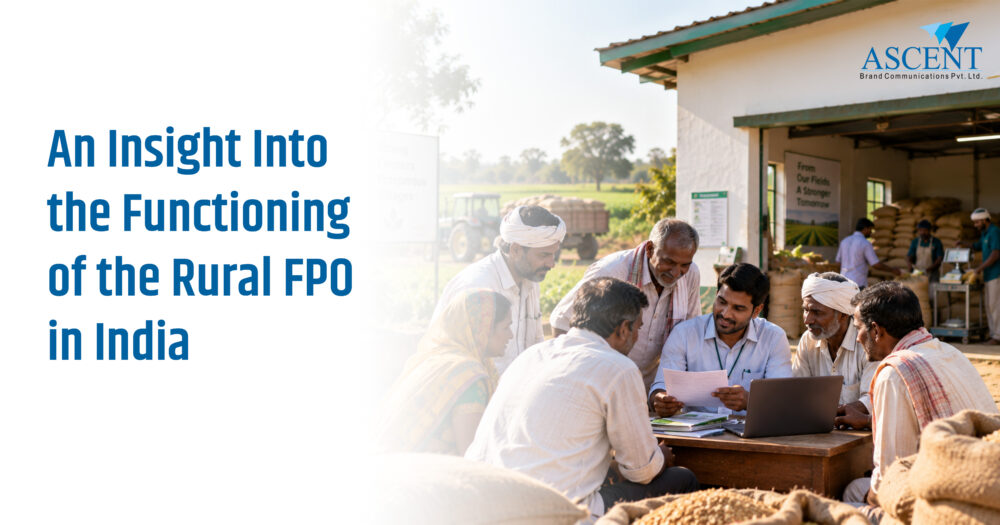
FPOs also play a role in transferring knowledge about entrepreneurship and collective farming to members who may otherwise lack access to this kind of support. According to the survey, group meetings and discussions with stakeholders were the primary method FPOs used to engage with farmers.
Since many small farmers are not comfortable with digital tools, in-person meetings remain the preferred format for building awareness. These are typically followed by group discussions, which give both farmers and FPO representatives a chance to raise questions and share feedback. Some FPOs also use local influencers to help spread awareness within their communities.
Conclusion
Supporting the livelihood of farmers is essential to the broader agricultural economy, and Farmer Producer Organizations offer a practical structure for achieving this. While FPOs continue to develop and mature as a model, challenges around market access and pricing remain significant. Strengthening marketing infrastructure and support systems will be important to helping FPOs realize their full potential across rural India.