Rural India has moved from being a market that banks tried to reach to one that financial brands now actively compete for. A farmer in Vidisha can receive a subsidy directly into a bank account, pay a seed dealer through UPI and check a crop insurance claim on a smartphone. A woman running a small tailoring unit in a Jharkhand village can take a microloan through her self-help group and repay it in weekly instalments.
The progress is real, but so are the gaps. Many accounts sit unused, formal credit still does not reach every household, and trust in financial products remains fragile. For banks, NBFCs, insurers, microfinance institutions and fintech companies, understanding both sides of this picture is the starting point for sustainable growth.
This article looks at where rural financial services stand today, the biggest opportunities for providers, the challenges that hold growth back and the marketing approaches that help financial brands earn trust in rural markets.
The Current State of Financial Services in Rural India
Access to basic banking has expanded sharply over the past decade. The Pradhan Mantri Jan Dhan Yojana (PMJDY) is the clearest example. By the first week of August 2025, total PMJDY accounts had reached 561 million, with 66.75 per cent of them, or 374.4 million, located in rural and semi-urban India.
Overall inclusion is also improving. The RBI’s Financial Inclusion Index rose to 67.0 in March 2025 from 64.2 a year earlier, with gains across all three sub-indices of access, usage and quality. The index runs from 0 to 100, so there is still considerable ground to cover.
Digital access has grown alongside banking access. According to the Internet in India 2024 report by Kantar and IAMAI, rural India has 488 million internet users, ahead of 397 million in urban India. This makes mobile the most important channel for reaching rural customers with financial products, information and service.
The shift now underway is from access to usage. Opening an account was the first step. Getting people to save regularly, borrow responsibly, insure their families and invest for the future is the harder and more valuable next step.
Understanding Rural Financial Needs
Rural financial needs are often misunderstood. Many providers still assume that rural credit demand is mostly about agriculture. In reality, households borrow and save for a wide range of reasons: building or repairing a home, paying for a child’s education, buying a two-wheeler, meeting medical expenses, running a small shop or managing a wedding.
Income patterns are the defining feature. A farming household may earn most of its annual income in two harvest seasons, while expenses continue every month. Daily wage workers and small traders face irregular earnings too. Financial products that assume a fixed monthly salary often fail in this environment.
This is why product design matters as much as distribution. A loan with repayments timed to harvest cycles, a savings product that accepts small and irregular deposits, or an insurance policy with a simple claims process will serve rural customers far better than a standard urban product with a regional-language brochure.
Formal and Informal Finance: Why the Gap Still Exists
Rural households use both formal and informal sources of finance. Public sector banks, regional rural banks, cooperative banks, NBFCs and microfinance institutions provide regulated services, often at lower interest rates, especially where government schemes support them.
Yet many households still turn to moneylenders, traders and relatives. The reasons are practical. Informal lenders are close by, know the borrower personally, need little paperwork and release money quickly. The cost is high interest and, in some cases, a cycle of debt that is hard to escape.
For formal providers, this gap is a clear opportunity. The task is to match the speed, convenience and personal trust of informal lenders while offering fairer terms and legal protection.
Opportunities in Rural Financial Services
Credit Beyond Agriculture
Rural credit demand extends well beyond crop loans. Micro, small and home-based enterprises need working capital. Families need housing finance, education loans and loans for consumer durables and vehicles. Gold loans remain popular because they are quick and familiar. Providers that recognise this diversity and design products for specific segments can grow faster than those focused only on farm lending.
Affordable housing finance is one example. Ascent has worked with lenders in this space, including Ummeed Housing Finance, which focuses on financing homes for underserved customers.
Microfinance and Self-Help Group Lending
Microfinance and self-help group (SHG) lending have shown that small borrowers without collateral can be reliable when products are designed around group accountability and regular contact. SHGs, many of them led by women, also act as strong channels for financial education and new product adoption.
Insurance and Risk Protection
Rural households are highly exposed to risk: crop failure, livestock loss, illness and accidents. Insurance penetration in these areas remains low, which makes crop, health, life, livestock and personal accident cover a significant growth area. Government schemes such as PMFBY, PMJJBY and PMSBY have raised awareness, but simple, affordable products with quick claim settlement are still in short supply.
Savings, Investments and Digital Payments
As incomes rise in rural and semi-urban areas, demand is growing for recurring deposits, small-ticket systematic investment plans, pension products and gold savings schemes. At the same time, UPI has made digital payments an everyday habit for millions of rural users. Payment data is also helping lenders assess customers who have no formal credit history.
New Digital Credit Infrastructure
The RBI’s Unified Lending Interface (ULI) is designed to bring together data such as land records, account information and other digital sources so that lenders can assess borrowers faster and with less paperwork. For small borrowers without traditional collateral, this can make formal credit far more accessible. Providers should track how ULI adoption develops and prepare their products and communication accordingly.
Challenges Facing Rural Financial Services
Low Awareness and Financial Literacy
Many rural customers are unaware of the products available to them, or do not understand features such as interest calculations, insurance exclusions or the difference between a loan and an overdraft. Without this understanding, people either avoid formal products or use them in ways that do not serve them well.
Dormant Accounts and Low Usage
Account ownership does not guarantee usage. Inactive accounts remain a concern across the system. At State Bank of India, for instance, the share of inoperative PMJDY accounts rose from 19 per cent in September 2024 to 25 per cent in September 2025. Bringing these customers back requires a clear reason to transact, not just an account number.
Last-Mile Delivery Costs
Serving customers spread across thousands of villages is expensive. Branches are costly to run in low-density areas, and much of the last-mile work falls on business correspondents. Industry commentary has noted that low payouts for the demanding work business correspondents do are putting strain on this channel, which remains essential for rural financial inclusion.
Collateral and Credit History
Many rural borrowers lack formal land titles, salary slips or credit scores. Traditional underwriting models exclude them, even when they have a steady ability to repay. Alternative data and new digital infrastructure are beginning to address this, but adoption across lenders is uneven.
Trust, Fraud and Digital Safety
Trust is fragile in rural markets. A single case of mis-selling, hidden charges or a delayed insurance claim spreads quickly through a village. The rise of digital payments has also brought new risks such as phishing calls, fake loan apps and OTP fraud. Customers who have been cheated once are often reluctant to try formal products again.
Language and Cultural Diversity
India’s rural markets are not one market. Language, crops, festivals, income cycles and social structures vary from district to district. Communication that works in western Uttar Pradesh may fall flat in coastal Andhra Pradesh.
Innovations Improving Rural Financial Access
Several developments are helping providers overcome these barriers. Business correspondent and agent networks bring basic banking to the village level. Micro ATMs and Aadhaar-enabled payment systems allow cash withdrawals and deposits without a branch. Mobile banking apps with vernacular and voice interfaces are making digital services easier for first-time users. Partnerships between banks, fintech companies, cooperatives and government programmes are also helping share costs and extend reach.
Data and AI are improving credit assessment, fraud detection and customer service, while digital public infrastructure such as UPI and account aggregators is lowering the cost of each transaction. The providers that benefit most are those that combine these tools with a strong on-ground presence, since rural customers often need to meet someone they trust before they commit.
How Financial Brands Can Build Trust in Rural Markets
Product and technology alone do not create adoption. Rural customers decide based on trust, clarity and word of mouth. This is where a well-planned rural marketing strategy makes the difference.
Speak the customer’s language. Communication should be in local languages and dialects, using simple examples drawn from daily life. Explaining an EMI through the cost of a cow or a tractor instalment makes it easier to understand than a percentage table.
Use trusted local voices. Sarpanches, SHG leaders, schoolteachers, input dealers and satisfied customers carry more credibility than any advertisement. Rural influencer marketing helps financial brands work with these voices in a structured way.
Meet customers where they gather. Haats, mandis, melas and village meetings are natural places to explain financial products face to face. Ascent’s article on mandis as a touch point to reach farmers covers this approach in more detail. Rural van marketing and farmer meets extend reach to remote villages.
Educate before you sell. Financial literacy sessions, street plays and folk media can explain savings, insurance and safe digital banking in an engaging way. Education builds trust and reduces the risk of mis-selling.
Combine on-ground and digital follow-up. After an activation, WhatsApp marketing and a rural call centre help keep conversations going, answer questions and convert interest into applications.
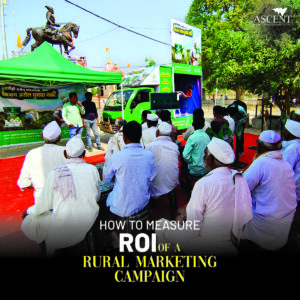
Measure what works. Track leads, account activations, loan applications and repeat usage by village and channel. Ascent’s guide on measuring the ROI of a rural marketing campaign explains how to set this up.
For more detail on lender-specific tactics, see Ascent’s article on marketing strategies of NBFCs in rural India.
An Illustrative Scenario: Launching a Rural Loan Product
Consider an NBFC launching small business loans for village shopkeepers in three districts of Madhya Pradesh. The product is sound, but awareness is low and many shopkeepers already borrow from local traders.
A structured launch would begin with rural market research to understand borrowing habits, repayment preferences and common concerns. Communication would then focus on two or three simple messages: quick approval, fair and transparent charges, and repayments that fit the shopkeeper’s cash flow. Field teams would hold meetings at weekly haats, supported by leaflets in Hindi and short video testimonials from early borrowers. Local distributors and SHG leaders would help identify interested customers, while a call centre and WhatsApp follow-up would manage enquiries.
Within the first season, the lender would track applications, approvals and repayment behaviour by village, and use these insights to refine both the product and the message before expanding to new districts.
Frequently Asked Questions
What are financial services for rural markets?
They are banking, credit, insurance, savings, investment and payment services designed for people living in villages and small towns. These include savings accounts, microloans, crop and health insurance, gold loans, housing finance and digital payments.
What are the biggest opportunities in rural financial services in India?
Key opportunities include credit for small businesses and households, microfinance, insurance, small-ticket savings and investment products, and digital payments. Rising internet use and new digital credit infrastructure are making these markets easier and cheaper to serve.
What challenges do financial service providers face in rural areas?
The main challenges are low financial literacy, dormant accounts, high last-mile delivery costs, lack of collateral and credit history, fraud risks and fragile trust in formal institutions.
How can banks and NBFCs market financial products in rural India?
Effective approaches include local-language communication, working with trusted community voices, activations at haats and mandis, financial literacy programmes, and digital follow-up through WhatsApp and call centres, with clear tracking of results.
Why is trust so important in rural financial marketing?
Rural customers often rely on personal relationships and word of mouth. A single negative experience can spread quickly and discourage others. Transparent communication and consistent service are essential to building long-term customer relationships.
Conclusion
Financial services for rural markets represent one of India’s largest growth opportunities, but success depends on more than product availability. Providers need products shaped around rural income patterns, delivery models that keep costs manageable and communication that builds genuine trust.
With more than 25 years of experience in rural and strategic marketing, Ascent helps banks, NBFCs, insurers and fintech companies reach rural customers with clarity and credibility. You can explore our work in the finance sector or speak to our team about your next rural launch.