
Every business begins with a vision. The founders know why the company exists, what it offers and who it is meant to serve. The harder part is getting customers, employees, dealers and investors to see that vision the same way.
This is where a brand communication agency adds value. It takes what a business stands for and turns it into messages, visuals and experiences that people understand, remember and act on.
The need for this has grown sharply in India. Customers now research on their phones, compare prices on marketplaces, read reviews and ask AI assistants for recommendations, all before speaking to a salesperson. The audience has also widened well beyond the metros. According to the Internet in India 2024 report by Kantar and IAMAI, India now has 886 million active internet users, and rural users number 488 million, ahead of 397 million in urban India. For a business, this means one brand message has to work in a corporate boardroom, on a WhatsApp group in a Tier 3 town and at a village market, without losing its meaning along the way.
What Is a Brand Communication Agency?
A brand communication agency is a specialist partner that plans, creates and manages how a business presents itself to every audience it deals with. This covers customers, channel partners, employees, investors and the wider public.
It is different from a traditional advertising agency. An advertising agency usually focuses on campaigns: a TV commercial, a print ad or a digital burst. A brand communication agency looks at the full picture. It asks whether the website, the sales brochure, the social media tone, the dealer meet, the job posting and the customer service reply all tell the same story. When they do, the brand becomes easier to trust.
Marketing or Communication: Which Matters More?
Business owners often ask whether they should invest in marketing or in communication strategy. Experienced marketers will not choose one over the other, because each depends on the other to work.
Marketing creates reach. Communication decides what people take away from that reach. A well-funded campaign with an unclear message spends money without building memory. A strong message with no distribution plan stays unheard. A brand communication strategy brings the two together so every rupee spent on visibility also builds recognition, preference and loyalty.
How a Brand Communication Agency Turns Vision Into Reality
1. Defining a Clear Brand Identity and Positioning
Every strong brand has a clear reason for being: why it exists, what it does and how it does it differently. A brand communication agency helps a business put this into words and then turn it into a practical framework.
This framework usually includes the brand’s positioning, core values, tone of voice, visual identity and key messages for each audience. It becomes the reference point for every piece of communication that follows.
A clear identity also makes change easier to manage. When customer expectations shift, a business may need a brand refresh, a rebrand or a brand migration after a merger. An agency that understands the brand’s foundation can guide these changes without confusing existing customers.
2. Building Two-Way Conversations With Customers
Communication is no longer a one-way broadcast. Customers expect brands to listen and respond.
When a customer shares a good experience, a simple “thank you” is a missed opportunity. A thoughtful reply that asks what they liked, or invites them to share more, turns a single comment into a relationship. The same applies to complaints. A prompt, human response in public often earns more goodwill than the original problem cost.
Over time, these conversations create advocates. Satisfied customers who feel heard recommend the brand to friends and family, which remains one of the most trusted sources of information for Indian buyers.
3. Creating Content That Is Relevant, Useful and Local
Good content answers the questions your audience is already asking. A brand communication agency studies what customers search for, what they discuss on social media and what they ask sales teams, and then builds content around those needs.
Relevance in India often means local relevance. A farm equipment brand speaking to farmers in Madhya Pradesh will connect better through Hindi video demonstrations and field-level stories than through a polished English brochure. A financial services company targeting first-time investors in smaller towns will earn more trust with simple explainers than with technical product sheets.
Content that is useful also performs better in search engines and AI-powered search tools, which increasingly reward clear, well-structured answers from credible sources.
4. Designing Marketing Collateral That Supports the Sale
Brochures, product catalogues, company profiles, presentations and point-of-sale material still play a major role, especially in B2B, industrial and rural markets. A sales representative visiting a distributor or a procurement head reviewing vendors needs material that is clear, accurate and easy to scan.
Well-designed collateral does three things. It explains the product or service in plain language, it highlights the benefits that matter most to that specific audience, and it reflects the company’s vision and track record. Short paragraphs, clear headings and specific proof points, such as capacity figures, certifications or client names, make collateral far more effective than long descriptive text.
5. Listening to Customer Feedback and User-Generated Content
Reviews, ratings, social media posts, comments and videos made by customers are a direct window into how people experience a brand. A good agency tracks this feedback closely and shares insights with the business.
These insights often lead to real improvements. A consumer brand may discover that customers find the packaging hard to open, or that a particular feature is being used in ways the company never expected. Once changes are made, the agency communicates them back to customers, showing that the brand listened. This builds credibility that paid advertising alone cannot buy.
6. Aligning Internal and External Communication
A brand is only as strong as the people who represent it. If employees do not understand or believe in the brand promise, customers will notice the gap.
Brand communication agencies increasingly support internal communication and employer branding alongside external campaigns. This includes employee onboarding material, leadership messaging, internal newsletters and recruitment communication. A manufacturing company, for example, may struggle to hire skilled technicians not because of pay, but because potential candidates do not know what the company stands for. Clear employer branding solves this and also strengthens the customer-facing brand.
7. Reaching Rural and Semi-Urban Audiences
A large share of India’s growth in consumption is coming from rural and semi-urban markets. Reaching these audiences requires more than translating an urban campaign into a regional language.
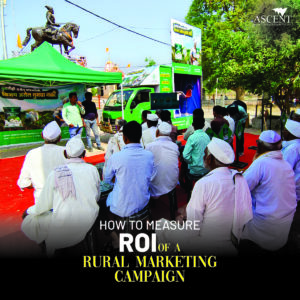
Effective rural brand communication combines on-ground activation, such as van campaigns, village-level events, demonstrations and haat promotions, with mobile-first digital content and the influence of trusted local voices such as retailers, farmers and community leaders. An agency with rural marketing experience understands the local context, the seasonal calendar and the practical challenges of reaching people in remote areas.
Brand Communication in Practice: An Illustrative Scenario
Consider an agri-inputs company launching a new seed variety across three states. The company’s vision is to help small farmers improve yields with reliable, affordable products.
A brand communication agency would begin by defining one clear message for farmers, such as higher yield with lower risk, and supporting it with proof from field trials. It would then plan communication for each audience. Farmers would receive demonstration plots, short video testimonials in local languages and village meetings. Dealers would receive training, product leaflets and point-of-sale material. The company’s own field staff would receive talking points and FAQs so that every conversation carries the same message.
After the launch, feedback from farmers and dealers would guide the next season’s communication. This is how a vision moves from a boardroom presentation to real results in the field.
How to Choose the Right Brand Communication Agency in India
Choosing an agency is a long-term decision. Before you sign, ask these questions:
- Does the agency understand your audience? Look for proven experience with the customers you want to reach, whether that is corporate buyers, urban consumers or rural communities.
- Can it deliver across channels? Your brand needs to be consistent across digital, print, on-ground and internal communication. An agency with integrated marketing communications capability avoids gaps between vendors.
- Does it start with strategy? A good agency asks about your business goals before it talks about creative ideas.
- Can it show measurable results? Ask for case studies with clear outcomes, such as reach, enquiries, sales growth or improved brand recall.
- Does it have ground-level execution capacity? For activation and rural campaigns, planning alone is not enough. The agency must be able to manage people, logistics and reporting on the ground.
Why Businesses Work With Ascent
At Ascent Brand Communications, we focus on two questions for every client: how the business will reach its audience, and how that audience will find and trust the business. Our brand communication strategies are built to deliver the right message to the right people at the right time.
Our work spans integrated marketing communications, rural marketing and campaign management, brand activation, experiential marketing, digital marketing, corporate communication, employer branding and agri marketing. This range allows us to keep a brand’s message consistent, whether it appears on a website, at a trade event or in a village square.
Frequently Asked Questions
What does a brand communication agency do?
A brand communication agency plans and manages how a business communicates with its audiences. This includes brand positioning, messaging, content, marketing collateral, digital communication, public relations, internal communication and on-ground activation.
How is a brand communication agency different from an advertising agency?
An advertising agency mainly creates and places campaigns. A brand communication agency looks after the overall consistency of a brand’s message across every channel and audience, including employees and partners.
Why is brand communication important for businesses in India?
India’s audiences are diverse in language, region and access to media. Clear and consistent brand communication helps a business build trust across urban and rural markets, compete with larger players and turn customers into long-term advocates.
Can a brand communication agency help with rural marketing?
Yes, if it has specialist rural experience. Rural brand communication combines local-language content, on-ground activations, demonstrations and mobile-first digital outreach to reach audiences in villages and smaller towns.
How do you measure the success of brand communication?
Common measures include brand awareness and recall, website traffic and enquiries, social media engagement, customer feedback, lead quality and sales growth in target markets. The right metrics depend on the objectives set at the start.
Conclusion
A business vision only creates value when the people who matter understand it and act on it. A brand communication agency makes that possible by giving the vision a clear voice, a consistent identity and the right channels to reach every audience.
If you are ready to build a brand that customers recognise, trust and recommend, speak to the Ascent team about your brand communication strategy.