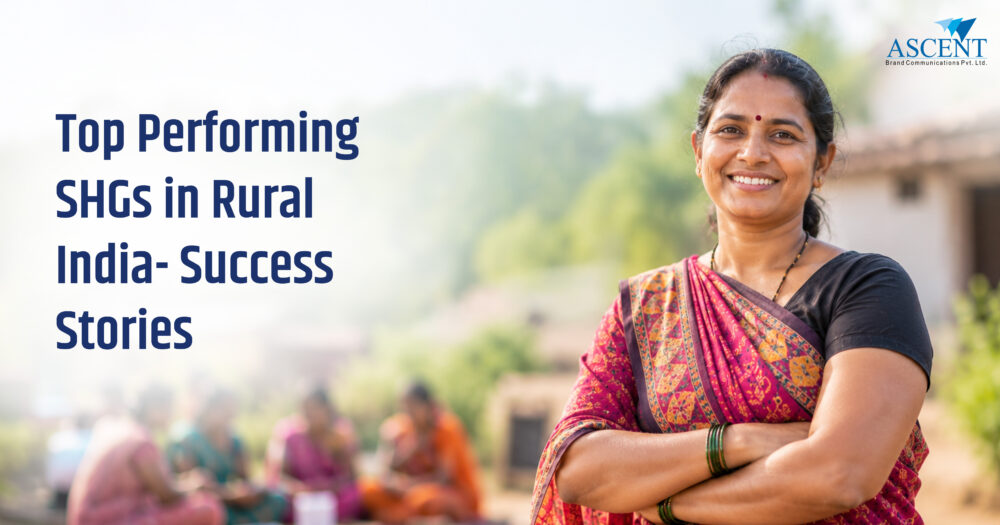
Across rural India, groups of 10 to 20 women meet every week or month, save small amounts of money together, lend to one another and gradually build businesses. These self-help groups (SHGs) have become one of the most powerful forces for rural livelihoods and women’s empowerment in the country.
The scale is remarkable. Under the Deendayal Antyodaya Yojana-National Rural Livelihoods Mission (DAY-NRLM), 10.05 crore women had been mobilised into 90.86 lakh SHGs as of 30 June 2024. Behind these numbers are countless individual stories of women who started with a few hundred rupees and built dairy units, spice businesses, weaving enterprises, fish farms and bakeries.
At Ascent, we work with brands to reach and connect with rural communities, and SHGs are among the most important institutions in rural India. Through secondary research, we have compiled some of the most inspiring SHG success stories from across the country, organised by region. Our aim is to celebrate these women-led enterprises and help cooperatives, businesses and public institutions discover potential partners.
What Is a Self-Help Group?
A self-help group is a small, informal group of people, usually 10 to 20 women from similar economic backgrounds, who come together voluntarily to save regularly, pool their savings in a common fund and give small loans to members based on group decisions. Over time, many SHGs link with banks to access larger loans and start income-generating activities together or individually.
SHGs combine access to low-cost financial services with self-management, collective decision-making and mutual support. They are usually formed and supported by government agencies, NGOs, banks and Krishi Vigyan Kendras (KVKs).
How SHGs Developed in India
India’s SHG movement grew from the SHG-Bank Linkage Programme, launched by NABARD in 1992 to connect small informal savings groups with formal bank credit. The government declared 2001 the Year of Women’s Empowerment, and SHG promotion expanded through schemes such as the Swarnajayanti Gram Swarozgar Yojana (SGSY).
In 2011, the government launched the National Rural Livelihoods Mission, later renamed DAY-NRLM, which organises SHGs into village organisations and cluster-level federations and provides them with a Revolving Fund, a Community Investment Fund and bank linkage. Its urban counterpart, DAY-NULM, supports SHGs in towns and cities.
The Lakhpati Didi Initiative
The government’s Lakhpati Didi initiative aims to help SHG women achieve sustainable incomes. A Lakhpati Didi is an SHG member whose annual household income is at least ₹1 lakh, with an average monthly income of at least ₹10,000 sustained for at least four agricultural seasons or business cycles.
Progress has been rapid. According to the Ministry of Rural Development, more than 3.46 crore SHG members had achieved Lakhpati Didi status by 31 March 2026, against an overall target of six crore. A 2025 impact evaluation by 3ie, covering about 23,000 households across nine states, found household incomes had risen by 9.5 per cent in NRLM blocks, with gains of 12 to 33 per cent in areas with mature community institutions.
SHG Success Stories at a Glance
| SHG | State | Main Activity |
| Chamoli SHGs | Uttarakhand | Temple prasad from local produce |
| Ganeshpur SHGs | Uttarakhand | Stitching, spices and food products |
| Himmotthan women’s cooperatives | Uttarakhand | Dairy, agri-produce, handicrafts |
| SEWA Ekta Swahyata Sahakarita | Uttarakhand | Spices, quinoa, tulsi |
| Mata Sundari SHG | Uttarakhand | Embroidered clothing, candles, agarbattis |
| Nari Shakti SHG | Punjab | Candles, pickles, food products |
| Manaksar SHG | Rajasthan | Stitching |
| Shri Ram SHG | Rajasthan | Toy making |
| Sangthan SHG | Rajasthan | Tailoring |
| Jai Ambe SHG | Rajasthan | Savings and credit |
| Ambe Mahila Mandal | Gujarat | Spices and household products |
| Chamunda Mahila Bachat Mandal | Gujarat | Stitching and embroidery |
| Gurukrupa SHG | Gujarat | Mango pulp |
| Lakshmi Sakhi Mandal | Gujarat | Handicraft retail |
| Shivshakti SHG | Gujarat | Masala production |
| Sfurti Mahila Mandal (SMILE) | Maharashtra | Handbags and handicrafts |
| Laavanya SHG | Maharashtra | Jewellery |
| Savan Mata and Nihal SHGs | Madhya Pradesh | Transport, poultry, organic farming |
| Kendrapara fish farming SHGs | Odisha | Pisciculture |
| Bhai Bhauni SHG | Odisha | Goat rearing |
| Maa Manikeswari SHG | Odisha | Vegetable cultivation |
| Suravi Dairy Farm | Odisha | Dairy |
| ASRLM vermicompost SHGs | Assam | Vermicomposting |
| Rupjyoti SHG | Assam | Handloom weaving |
| Manasha SHG | Assam | Dairy |
| Kudumbashree | Kerala | Multiple enterprises |
| Sadhu Deepthi SHG | Kerala | Dairy, goats, poultry, organic vegetables |
| Kathiravan and Malar SHGs | Tamil Nadu | Soap manufacturing |
| Mahalir Mandram Poongarun III | Tamil Nadu | Flower cultivation and tourism services |
SHG Success Stories From North India
Chamoli SHGs, Uttarakhand: Prasad From Local Produce
Women’s SHGs near the Badrinath temple in Chamoli district built a successful business making prasad from locally grown produce such as chaulai (amaranth) and selling it at the shrine. The groups reported a profit of ₹10 lakh on a total income of ₹18 lakh. Laxmi Rawat, a member from Paini village, said each member earned between ₹10,000 and ₹20,000 in a short period. Following this success, the state government pledged to help SHGs set up similar businesses near 625 temples across Uttarakhand.
Ganeshpur Village SHGs, Uttarkashi, Uttarakhand
Pushpa Chauhan, Gram Pradhan of Ganeshpur village, helped found the village’s first SHG in 2011. By 2018, the village had 15 women’s groups of 10 to 15 members each, and most women in the community belonged to one. Work is divided among the groups: some stitch school uniforms while others make and sell spices and food products. Monthly profits range from ₹1,000 to ₹4,000 per member, earned alongside farming.
Himmotthan Women’s Cooperatives, Uttarakhand
With the support of partner organisations, Himmotthan has helped establish 47 women’s cooperatives in Uttarakhand, registered under the state’s Self Reliant Cooperative Act, 2003. Representing SHGs and village organisations, they promote microfinance-based livelihoods in dairy, common facility centres and agri-produce enterprises. Some have moved into niche markets such as wool handicrafts, havan kits, tourism and value-added agricultural products. Himmotthan, working with the Tata Relief Committee and Tata Trusts, also supported relief efforts in more than 200 communities after the 2013 Uttarakhand disaster.
SEWA Ekta Swahyata Sahakarita Cooperative, Almora, Uttarakhand
With support from SEWA Bharat, 125 women farmers set up their own producer cooperative in June 2013. It has since grown to involve 680 women farmers across 27 villages, with 350 shareholders. After training in organic certification, manure production and crop management, members moved into higher-value crops such as quinoa and tulsi alongside chilli, turmeric and coriander, and added value through spice grinding and packaging.
SEWA Bharat’s wider work in Uttarakhand has mobilised more than 24,000 informal women workers across Almora, Dehradun, Mussoorie and Rudraprayag since 2006, connecting them with livelihood training, health insurance and government schemes. Its 45 SHGs, with 433 members, reported combined savings of over ₹18.4 lakh and loans of nearly ₹30 lakh.
Mata Sundari SHG, Rameswarpur, Udham Singh Nagar, Uttarakhand
Members of Mata Sundari SHG used their savings to buy two embroidery machines and now make embroidered clothing, along with candles and agarbattis, for local markets. Recognising the village’s entrepreneurship, the district administration provided a ₹1.5 lakh grant for a hall and storeroom, built on the gurudwara grounds with a further ₹3 lakh contributed by villagers. The Swajal Project added ₹15,000 to a revolving fund, and a bank sanctioned a cash credit limit.
Nari Shakti SHG, Punjab
Established in 2013 with support from the NGO PAHAL, Nari Shakti SHG began with candle making and mango pickles, supported by a ₹40,000 loan repaid through regular instalments. The group enforced discipline with small fines for missed meetings. Members later expanded into clothing, bags, nurseries, dairy, goat rearing and organic food products, and began selling at exhibitions in major cities.
Manaksar SHG, Hanumangarh, Rajasthan
Led by Parmjeet Kaur, 10 women in Manaksar village formed an SHG with guidance from the local KVK, which provided vocational training in stitching. Members opened a bank account, began saving and lending internally, and invested in quality materials. Each member now earns ₹5,000 to ₹6,000 a month, and demand for their products is growing in nearby areas.
Shri Ram SHG, Sangaria, Rajasthan
With support from KVK experts, 12 women formed Shri Ram SHG and received training in running the group, maintaining records and saving, along with vocational training in toy making. They buy quality raw materials and produce toys to order. Each member earns around ₹22,000 a year, and the group has inspired women in neighbouring villages.
Sangthan SHG, Bholusar, Churu, Rajasthan
In the Thar desert district of Churu, where rain-fed farming leaves families without income for several months a year, the KVK formed Sangthan SHG with 10 women from disadvantaged backgrounds in January 2011. After long-duration tailoring training, each participant received a sewing kit. Members now earn an average net profit of about ₹2,300 a month, with incomes ranging from ₹1,350 to ₹4,000.
Jai Ambe SHG, Rajasthan
Members of Jai Ambe SHG, many from the Meena community, each contribute ₹25 a week to a common fund that any member can borrow from in times of need. Most members have taken small loans, showing how even modest regular savings can provide a vital financial safety net.
SHG Success Stories From West India
Ambe Mahila Mandal, Mehsana, Gujarat
Kokilaben Goswami of Kherva village first ran a small beauty salon to supplement her family’s income. After training from KVK Mehsana in spice value addition and marketing, she formed Ambe Mahila Mandal with seven other women. Starting with ₹5,000, the group sold household products and then began producing chilli, turmeric and coriander powder. With KVK support, they bought a packaging sealer and sold their products at Krishi Melas and other events. Members now earn around ₹10,000 a month each.
Chamunda Mahila Bachat Mandal, Kaneri, Junagadh, Gujarat
In Kaneri village, where many families depend on seasonal farm labour, KVK Junagadh helped 20 women form an SHG and open a bank account. After training in stitching and embroidery, member Jyotsana Nareshbhai Bahrathi started a tailoring business with the KVK’s help in buying a machine. As the only tailor in her village, she now earns around ₹200 a day and has become a role model for other women.
Gurukrupa SHG, Valsad, Gujarat
In Valsad, a tribal district where mango is a major crop, many farmers were forced to sell their fruit at low prices. In 2007-08, the KVK trained farm women in Ambheti village in mango pulp processing, supported by the Tribal Sub-Plan. The women formed Gurukrupa SHG, and each member now earns ₹15,000 to ₹20,000 a year. Group leader Kusumben Kalidas Patel alone fills more than 1,000 bottles of mango pulp annually, earning ₹45,000 to ₹55,000 a year.
Lakshmi Sakhi Mandal, Bhanvad, Gujarat
Formed by 12 women from low-income households under Gujarat’s Sakhi Mandal scheme, this group started with savings of ₹100 per member each month. Two members opened a shop at the Gramhaat in Dhamli village, a tourist location, selling china clay artefacts and handmade goods sourced from Rajkot, Surendranagar and Junagadh. More than 4,400 women in Bhanvad Taluka are now SHG members, with combined savings of ₹80 lakh.
Shivshakti SHG, Kalakava, Gujarat
In Kalakava village, tribal women with small landholdings depended on seasonal farm work. KVK Vyara trained them in masala preparation in 2011, and 10 of the 19 members started a spice business with a ₹50,000 loan from Bank of Baroda. They bought grinding, weighing and sealing equipment, and the KVK helped with branding and market access. The group earns ₹14,000 to ₹16,000 a month and earned over ₹1.5 lakh between January 2012 and March 2013.
Sfurti Mahila Mandal and SMILE, Pune, Maharashtra
Sfurti Mahila Mandal in Pune set up SMILE (Savitri Marketing Institute for Ladies Empowerment) in 1998 as a joint venture with Pune Municipal Corporation, bringing 15 women’s SHGs under one organisation. Members make handbags, block-printed bags, toys, papier-mâché and embroidered products, with design support from partners. SMILE now runs three retail outlets in Pune, and the Maharashtra government has encouraged similar marketing initiatives across the state.
Laavanya SHG, Pragati Foundation, Maharashtra
Pranali, from a low-income family and married at 19, joined Pragati Foundation’s three-month jewellery training programme after hearing about it from community leaders. Initially shy and hesitant, she excelled in the course and now runs her own jewellery training programme for the foundation. As a member of Laavanya SHG, she hopes to expand sales and eventually export her jewellery.
SHG Success Stories From Central India
Savan Mata and Nihal SHGs, Madhya Pradesh
Sunita Bilwal of Savan Mata SHG in Tundikheda village, Sheopur district, drives an Ajeevika Express vehicle for rural transport and earns ₹5 to 6 lakh a year from poultry and fruit farming. Noori Begum of Nihal SHG in Channaudi village, Shahdol district, runs an organic farming and housekeeping business and also trains other women. Both show how SHG members are moving into diverse, higher-income enterprises.
SHG Success Stories From East and Northeast India
Kendrapara Fish Farming SHGs, Odisha
In Kendrapara district, around 389 SHGs with about 4,000 women members have taken up fish farming with support from the state Fisheries Department, which provides a 60 per cent subsidy of up to ₹90,000 per group. Baba Jaleswar SHG, formed in 2018 under the Rashtriya Krishi Vikas Yojana, cleaned the village pond and began raising fish. Secretary Anjali Sethi says members now earn ₹3,000 to ₹5,000 a month. Members of Mahaveer Women SHG and Maa Budhi Mangala Women SHG report similar incomes, and are now contributing to family finances rather than depending on others.
Bhai Bhauni SHG, Dhenkanal, Odisha
Formed by 10 women under the Integrated Watershed Management Programme (IWMP), Bhai Bhauni SHG received a livelihood revolving fund of ₹19,372 in March 2013. The members bought 10 goats for ₹24,000, shared the profits, and fully repaid the revolving fund. Their improved financial position has encouraged other women in the area to form SHGs.
Maa Manikeswari SHG, Kalahandi, Odisha
In a remote village in Kalahandi district, members of Maa Manikeswari SHG grow and sell vegetables such as brinjal, cauliflower, carrots, cabbage, chillies, okra and papaya to traders from nearby towns. Each member earns at least ₹5,000 a month. Group leader Satyabhama plans to take a loan to invest in better seeds and inputs and expand cultivation.
Suravi Dairy Farm, Ranapur, Nayagarh, Odisha
In 1998, 15 women from below-poverty-line families formed an SHG with support from World Vision. After receiving a ₹10,000 revolving fund, they were selected under SGSY, and a bank loan helped them build a common dairy shed and buy 15 milch cows. The group now produces 90 litres of milk a day for the Puri Milk Union and has taken three acres of land for fodder cultivation.
Vermicomposting SHGs, Assam
The Assam State Rural Livelihoods Mission (ASRLM) has adopted vermicomposting, which uses earthworms to convert organic waste into nutrient-rich fertiliser, as a livelihood activity for SHGs. Working with KVKs and MGNREGA, ASRLM is expanding organic fertiliser production and helping SHGs build a sustainable income source.
Rupjyoti SHG, Doligaon, Jorhat, Assam
Founded in 2006 with 20 women members, Rupjyoti SHG meets twice a month, with each member depositing ₹30 monthly. Members are skilled weavers who make gamosas, mekhela sadors, woollen shawls and other traditional Assamese textiles on their own handlooms, along with embroidered items such as pillow covers and tablecloths.
Rupa Goswami, Manasha SHG, Lakhimpur, Assam
After joining Manasha SHG under ASRLM, Rupa Goswami received training and took a ₹30,000 loan through a micro credit plan to start a small dairy unit. She repaid the loan through milk sales and expanded to seven Jersey cows producing 40 litres of milk a day. She now earns around ₹29,000 to ₹31,000 a month.
Kenduasuli SHGs
Sibani Baskey, from a farming family in Kenduasuli village, worked with a local KVK from 2000, receiving training in low-cost nutrition, kitchen gardening and sal leaf plate making. She formed an SHG with eight other farm women in partnership with the panchayat and went on to help establish four more groups. The village’s SHGs now rear goats, pigs and heifers and work as agricultural labour collectives.
Sandhya Bhakta, ABHA SHG
Sandhya Bhakta’s ABHA SHG received a Revolving Fund, a Community Investment Fund and bank credit of ₹1.5 lakh, and has saved more than ₹40,000 since 2012. With a ₹60,000 loan from the group, Sandhya expanded her bakery and moved from retail to wholesale. She now employs four people and earns about ₹32,000 a month.
SHG Success Stories From South India
Kudumbashree, Kerala
Launched by the Kerala government in the late 1990s to reduce poverty and empower women, Kudumbashree (meaning “prosperity of the family” in Malayalam) has become one of the largest women’s community networks in the world, with several million members. Its neighbourhood groups run enterprises in food services, farming, tailoring and more. Its catering units have earned a strong reputation, for example by cooking and serving meals to polling staff in Thiruvananthapuram using only steel utensils under the Green Protocol. Kudumbashree also helps other states develop similar programmes.
Sadhu Deepthi SHG, Kakkayam, Kozhikode, Kerala
Around 20 farm women, most without formal education, formed Sadhu Deepthi SHG and linked it with a cooperative bank to finance several businesses. Members grow organic vegetables with their own vermicompost, run dairy units selling milk to the local cooperative, rear Tellicherry goats, raise poultry and have even tried ornamental fish. Each member now earns ₹5,000 to ₹9,000 a month, and the supporting KVK was rated “outstanding” by NABARD for its work with farmer organisations in Kerala.
Kathiravan and Malar SHGs, Thanjavur, Tamil Nadu
Formed in 2000 under the Tamil Nadu Corporation for Development of Women, these two SHGs received a ₹7.5 lakh loan under SGSY, including a ₹2.5 lakh subsidy, to start bath soap production in 2005. They repaid the loan in four years. With training in production, branding and marketing, the unit can produce up to 17,500 soaps a day in herbal variants such as aloe vera, neem, turmeric and sandalwood, and has worked as a contract manufacturer for several companies.
Mahalir Mandram Poongarun III, Yelagiri Hills, Tamil Nadu
This SHG, supported by the Social Education Movement, began by collecting shenbaga flowers and selling them to wholesalers at 50 paise each. With the profits, members started growing roses and marigolds, selling half to wholesalers and the rest directly in town for higher margins. Recognising their success, the district administration leased them the Punganur lake park operations, including boating and the garden, as well as a shop to sell SHG products to tourists.
Organisations and Programmes Supporting Rural Women
Many organisations help SHGs and rural women build livelihoods. A few examples:
Maher. This organisation forms SHGs in villages, trains members to maintain records, links groups to nationalised banks, provides skill training, supports income-generating programmes and encourages women’s participation in Panchayati Raj institutions.
PHD Family Welfare Foundation. The social arm of the PHD Chamber of Commerce and Industry delivers CSR programmes across several northern states. Its centres train women and girls in tailoring, beauty culture, spoken English and nursing assistance, with nursing trainees receiving six months of theory and hospital-based training.
DAY-NULM and urban SHG federations. Under the Deendayal Antyodaya Yojana-National Urban Livelihoods Mission, urban poor households are organised into SHGs, which join Area Level Federations and City Level Federations. These federations help with bank linkage, advocacy with local governments and marketing of SHG products.
Rural Self Employment Training Institutes (RSETIs). Bank-sponsored RSETIs provide free entrepreneurship training. Monimala Bora Mohan of Bokakhat, Assam, raised her monthly income from ₹5,000 to ₹20,000 after poultry training at RSETI UBI Golaghat. Babul Debnath of Chirang, Assam, built a dairy business supplying 30 to 40 litres of milk a day after training at SBI RSETI Chirang.
DDU-GKY. Under the Deen Dayal Upadhyaya Grameen Kaushalya Yojana, rural youth receive free skills training linked to jobs. Gita Kurmi from Sivasagar, Assam, trained in customer relationship management and progressed from a starting salary of ₹7,200 to ₹17,893 a month.
SHGs during COVID-19. During the 2020 lockdown, SHGs and NGOs across India produced masks and sanitisers for frontline workers. In Gujarat alone, SHG women under the Gujarat Urban Livelihood Mission made more than 13 lakh masks in about two weeks, earning around ₹300 a day while working from home. Similar efforts took place in Vellore district in Tamil Nadu and in Delhi through organisations such as Amba Foundation, Aastha Welfare Society, Chintan and Mahila Housing Sewa Trust.
What These Success Stories Have in Common
Across regions and activities, a few factors appear again and again:
- Regular savings and discipline: consistent small contributions and meeting attendance build trust and a financial base.
- Skill training: KVKs, RSETIs and NGOs often provide the technical training that turns savings into a business.
- Access to credit: revolving funds, community investment funds and bank loans allow groups to invest and scale.
- Market linkages: the most successful groups find reliable buyers, whether through melas, cooperatives, retail outlets or institutional customers.
- Collective strength: federations and cooperatives give SHGs bargaining power and access to larger markets.
Why SHGs Matter to Brands and Businesses
SHGs are not only livelihood institutions. They are also trusted networks that reach millions of rural households. For businesses, they can be:
- Distribution partners: some companies have built rural sales networks with SHG women as micro-entrepreneurs, with Hindustan Unilever’s Project Shakti among the best-known examples.
- Suppliers and producers: SHGs produce spices, food products, textiles, handicrafts and dairy that can be sourced by larger businesses.
- Trusted influencers: SHG leaders are respected voices in their communities. See Ascent’s rural influencer marketing service.
- Customers: SHG members with growing incomes are an important market for financial services, household products, mobile phones and more. See Ascent’s article on financial services for rural markets.
- CSR and community partners: SHGs are natural partners for livelihood, health and education programmes.
Ascent’s guide to major rural marketing touchpoints explains how SHGs and NGOs fit into a wider rural engagement strategy, and our article on why rural marketing is an important strategy in the Indian market sets out the bigger opportunity.
Frequently Asked Questions
What is a self-help group (SHG)?
A self-help group is a small group, usually of 10 to 20 women from similar backgrounds, who save regularly, pool their money in a common fund and lend to members. Many SHGs link with banks and start income-generating activities.
How many SHGs are there in India?
Under DAY-NRLM, about 10.05 crore women had been mobilised into 90.86 lakh SHGs as of 30 June 2024.
Who is a Lakhpati Didi?
A Lakhpati Didi is an SHG member whose annual household income is at least ₹1 lakh, sustained for at least four agricultural seasons or business cycles. More than 3.46 crore SHG members had achieved this status by 31 March 2026.
How do SHGs get financial support?
SHGs build funds from members’ savings and can access a Revolving Fund and Community Investment Fund under DAY-NRLM, as well as bank loans through the SHG-Bank Linkage Programme. Some also receive support from state departments, NGOs and CSR programmes.
How can businesses work with SHGs?
Businesses can partner with SHGs as distributors, suppliers, community influencers and CSR partners. Successful partnerships respect the group’s goals, offer fair terms and provide training and market access.
Conclusion
The stories in this article show what rural women can achieve when savings, skills, credit and market access come together. From prasad makers in Chamoli and fish farmers in Kendrapara to weavers in Jorhat and soap makers in Thanjavur, SHGs are building livelihoods, strengthening families and changing rural economies.
Governments, banks, NGOs and businesses all have a role in helping SHGs grow further, through training, finance, fair market linkages and long-term partnerships.
Ascent works with brands to build meaningful connections with rural communities through strategic rural marketing, rural market research and rural distribution planning. If you are exploring partnerships with SHGs or rural women entrepreneurs, we would be glad to help.