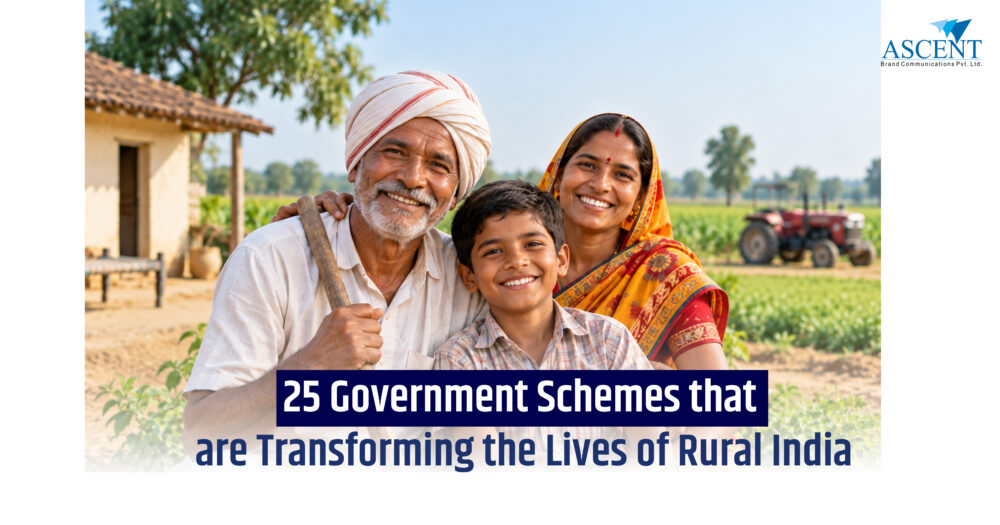
Nearly two-thirds of India’s population lives in rural areas. Over the past decade, a wide range of government schemes has changed daily life in villages in visible ways: tap water at home, cooking gas in place of firewood, bank accounts, all-weather roads, health cover, and direct cash support for farmers.
These programmes do more than provide welfare. They are raising incomes, improving health, bringing women into the workforce, and connecting rural households to the formal and digital economy. For anyone working with rural India, whether in policy, development, or business, understanding these schemes is essential.
This guide covers 25 key central government schemes, grouped by theme, with an updated view of recent changes up to 2026.
Key Takeaways
- Rural employment policy has changed significantly, with the VB-G RAM G Act replacing MGNREGA from 1 July 2026 and raising the employment guarantee to 125 days.
- Women’s self-help groups have become a major driver of rural enterprise, with more than 3 crore women reaching Lakhpati Didi status.
- Farmer support now combines direct income transfers, insurance, credit, irrigation, and targeted district-level development.
- Better housing, water, energy, roads, and digital access are steadily raising rural living standards and aspirations.
Government Schemes at a Glance
No. |
Scheme |
Focus Area |
| 1 | VB-G RAM G (formerly MGNREGA) | Rural employment |
| 2 | DAY-NRLM and Lakhpati Didi | Women’s livelihoods |
| 3 | Namo Drone Didi | Women and agri technology |
| 4 | Deendayal Upadhyaya Grameen Kaushalya Yojana | Youth skilling |
| 5 | PM Vishwakarma | Artisans and craftspeople |
| 6 | PM-KISAN | Farmer income support |
| 7 | Pradhan Mantri Fasal Bima Yojana | Crop insurance |
| 8 | Kisan Credit Card | Farm credit |
| 9 | PM-KUSUM | Solar energy for farms |
| 10 | Soil Health Card | Soil testing |
| 11 | e-NAM | Agricultural markets |
| 12 | Pradhan Mantri Krishi Sinchayee Yojana | Irrigation |
| 13 | PM Dhan-Dhaanya Krishi Yojana | District agriculture development |
| 14 | Pradhan Mantri Matsya Sampada Yojana | Fisheries |
| 15 | Pradhan Mantri Awas Yojana – Gramin | Rural housing |
| 16 | Jal Jeevan Mission | Tap water |
| 17 | Swachh Bharat Mission – Grameen | Sanitation |
| 18 | Pradhan Mantri Gram Sadak Yojana | Rural roads |
| 19 | Pradhan Mantri Ujjwala Yojana | Clean cooking fuel |
| 20 | BharatNet | Rural broadband |
| 21 | SVAMITVA | Property rights |
| 22 | Pradhan Mantri Jan Dhan Yojana | Banking access |
| 23 | PMJJBY and PMSBY | Life and accident insurance |
| 24 | Ayushman Bharat PM-JAY | Health cover |
| 25 | PM Garib Kalyan Anna Yojana | Food security |
Employment and Livelihood Schemes
1. Viksit Bharat – Guarantee for Rozgar and Ajeevika Mission (Gramin), or VB-G RAM G
For nearly two decades, MGNREGA was India’s main rural employment guarantee. In 2026, it was replaced by a new law. The VB-G RAM G Act came into force across all states and Union Territories on 1 July 2026, and MGNREGA stood repealed from the same date.
What it offers: Every rural household whose adult members volunteer for unskilled manual work is entitled to 125 days of guaranteed wage employment in a financial year, up from 100 days under MGNREGA. Wages are to be paid weekly or within 15 days of the muster roll closing, with compensation for delays.
Why it matters: The scheme provides a safety net during lean agricultural seasons and funds village assets such as water conservation structures and rural infrastructure. The Centre has allocated ₹95,692.31 crore for 2026-27. The transition has also drawn debate, including on the funding share of states and the new implementation model, so its on-ground impact will become clearer over the coming year.
2. Deendayal Antyodaya Yojana – National Rural Livelihoods Mission (DAY-NRLM) and Lakhpati Didi
DAY-NRLM organises rural women into self-help groups (SHGs) and supports them with training, credit, and market access. The Lakhpati Didi initiative, launched under the mission in 2023, aims to help SHG women earn a sustainable annual household income of more than ₹1 lakh.
Why it matters: The programme has become one of the largest drivers of women-led enterprise in the country. The government reached its target of 3 crore Lakhpati Didis a year ahead of the March 2027 deadline and has now set a new goal of 6 crore by March 2029. SHG women today run businesses in dairy, food processing, handicrafts, retail, and services across villages.
3. Namo Drone Didi
This scheme provides drones to women’s SHGs so they can offer agricultural services such as spraying fertilisers and pesticides to farmers on a rental basis.
Why it matters: It creates a new source of income for rural women while giving farmers access to faster and more precise crop spraying. It also brings modern technology directly into village economies.
4. Deendayal Upadhyaya Grameen Kaushalya Yojana (DDU-GKY)
DDU-GKY provides placement-linked skill training to rural youth from poor families, helping them move into formal jobs in sectors such as retail, hospitality, healthcare, and manufacturing.
Why it matters: It helps young people from villages access steady salaried employment and builds skills that increase their long-term earning potential.
5. PM Vishwakarma
Launched in 2023, PM Vishwakarma supports traditional artisans and craftspeople, such as carpenters, blacksmiths, potters, tailors, and cobblers.
What it offers: Skill training, a toolkit incentive, collateral-free credit at concessional rates, and support for digital transactions and marketing.
Why it matters: Many of these trades are rooted in rural and small-town economies. The scheme helps artisans modernise their work and reach larger markets.
Agriculture and Farmer Welfare Schemes
6. PM-KISAN (Pradhan Mantri Kisan Samman Nidhi)
PM-KISAN provides eligible landholding farmer families with ₹6,000 a year, paid in three equal instalments directly into their bank accounts.
Why it matters: The assured income helps farmers buy seeds, fertilisers, and other inputs at the start of each season. Direct Benefit Transfer reduces leakages and delays.
7. Pradhan Mantri Fasal Bima Yojana (PMFBY)
PMFBY offers crop insurance at low premium rates, covering losses from natural calamities, pests, and diseases.
Why it matters: A single failed season can push a farming family into debt. Insurance protects income and gives farmers more confidence to invest in their crops.
8. Kisan Credit Card (KCC)
The KCC scheme gives farmers timely access to short-term credit for cultivation, animal husbandry, and fisheries at subsidised interest rates. The Union Budget 2025-26 raised the loan limit under the modified interest subvention scheme from ₹3 lakh to ₹5 lakh.
Why it matters: Affordable formal credit reduces dependence on moneylenders, who often charge very high interest rates.
9. PM-KUSUM (Pradhan Mantri Kisan Urja Suraksha evam Utthaan Mahabhiyan)
PM-KUSUM supports farmers in installing solar pumps, solarising existing grid-connected pumps, and setting up small solar power plants on unused land.
Why it matters: Solar irrigation cuts diesel costs, reduces dependence on unreliable power supply, and in some cases allows farmers to earn by selling surplus electricity.
10. Soil Health Card Scheme
Under this scheme, farmers receive a report on the nutrient status of their soil, along with recommendations on fertiliser use.
Why it matters: Balanced fertiliser use lowers input costs, improves yields, and protects long-term soil health.
11. e-NAM (National Agriculture Market)
e-NAM is an online trading platform that links agricultural mandis across the country, allowing buyers from different locations to bid for produce.
Why it matters: Wider competition among buyers and transparent pricing can help farmers get better returns for their produce.
12. Pradhan Mantri Krishi Sinchayee Yojana (PMKSY)
PMKSY aims to expand irrigation coverage under the principle of “Har Khet Ko Pani” and promote efficient water use through micro-irrigation under “Per Drop More Crop.”
Why it matters: Reliable irrigation reduces dependence on rainfall, while drip and sprinkler systems help farmers grow more with less water.
13. PM Dhan-Dhaanya Krishi Yojana
This is one of the newest farm schemes. The Union Cabinet approved it in July 2025 for six years, starting in 2025-26, to cover 100 districts. Districts are selected based on low productivity, low cropping intensity, and low credit disbursement.
Why it matters: The scheme focuses on improving productivity, crop diversification, sustainable practices, post-harvest storage, irrigation, and credit access. It works by bringing together 36 existing schemes across 11 departments, along with state schemes and private sector partnerships.
14. Pradhan Mantri Matsya Sampada Yojana (PMMSY)
PMMSY supports the fisheries sector through investment in infrastructure, modern fishing practices, cold chains, and market linkages.
Why it matters: Fisheries provide livelihoods to millions of people in coastal and inland rural communities. The scheme helps increase production, reduce post-harvest losses, and raise incomes.
Housing, Water, Sanitation, and Infrastructure Schemes
15. Pradhan Mantri Awas Yojana – Gramin (PMAY-G)
PMAY-G provides financial assistance to eligible rural families to build a permanent (pucca) house with basic amenities. The scheme has been extended to support construction of additional houses in the coming years.
Why it matters: A secure home improves safety, health, and dignity. Housing construction also creates local employment and demand for building materials.
16. Jal Jeevan Mission (JJM)
JJM aims to provide functional household tap water connections to every rural home.
Why it matters: Tap water at home saves women and girls hours spent collecting water each day and reduces waterborne diseases.
17. Swachh Bharat Mission – Grameen (SBM-G)
After a large-scale drive to build household toilets and end open defecation, the mission’s second phase focuses on sustaining those gains and managing solid and liquid waste in villages.
Why it matters: Better sanitation improves public health, particularly for women and children, and makes villages cleaner and safer.
18. Pradhan Mantri Gram Sadak Yojana (PMGSY)
PMGSY builds all-weather roads to connect rural habitations. Its latest phase targets habitations that are still unconnected.
Why it matters: Roads improve access to markets, schools, hospitals, and jobs. They also make it easier for businesses to distribute products to villages.
19. Pradhan Mantri Ujjwala Yojana (PMUY)
PMUY provides free LPG connections to women from poor households, replacing traditional cooking fuels such as firewood and cow dung.
Why it matters: Clean cooking fuel reduces indoor air pollution, protects women’s health, and saves time spent collecting fuel.
20. BharatNet
BharatNet aims to provide high-speed broadband connectivity to gram panchayats and villages through an optical fibre network.
Why it matters: Reliable internet access enables online education, telemedicine, digital payments, e-governance services, and new rural businesses.
21. SVAMITVA Scheme
SVAMITVA uses drone surveys to map rural residential land and issue property cards to households.
Why it matters: Clear property records reduce land disputes and allow villagers to use their property as collateral to access bank loans.
Financial Inclusion, Health, and Social Security Schemes
22. Pradhan Mantri Jan Dhan Yojana (PMJDY)
PMJDY brought crores of Indians into the formal banking system through zero-balance accounts with RuPay debit cards and accident insurance cover.
Why it matters: Jan Dhan accounts are the foundation for Direct Benefit Transfers under many other schemes, ensuring that subsidies and payments reach beneficiaries directly.
23. Pradhan Mantri Jeevan Jyoti Bima Yojana (PMJJBY) and Pradhan Mantri Suraksha Bima Yojana (PMSBY)
These two schemes offer affordable life insurance and accidental death and disability insurance, respectively, for a small annual premium deducted from the subscriber’s bank account.
Why it matters: They provide a basic financial safety net to families who previously had no insurance at all.
24. Ayushman Bharat – Pradhan Mantri Jan Arogya Yojana (AB PM-JAY)
AB PM-JAY provides health cover of up to ₹5 lakh per family per year for secondary and tertiary hospital care at empanelled public and private hospitals. Coverage has also been extended to all senior citizens aged 70 and above, regardless of income.
Why it matters: Medical expenses are one of the most common reasons rural families fall into debt. Cashless treatment protects household savings.
25. Pradhan Mantri Garib Kalyan Anna Yojana (PMGKAY)
PMGKAY provides free food grains to beneficiaries under the National Food Security Act through the public distribution system.
Why it matters: Free food grains protect poor households from hunger and free up income for other essential needs such as education and health.
The Combined Impact on Rural India
Individually, each of these schemes addresses a specific need. Together, they are changing the overall economic and social picture of rural India.
Higher and more stable incomes. Direct transfers, employment guarantees, women’s enterprises, and better farm support give rural households more financial stability.
Improved quality of life. Pucca houses, tap water, toilets, clean cooking fuel, and electricity have raised basic living standards in millions of homes.
Stronger role for women. Self-help groups, Lakhpati Didi, Namo Drone Didi, and Ujjwala have increased women’s income, decision-making power, and participation in the economy.
Digital and financial connection. Bank accounts, digital payments, and broadband have linked rural India to the formal and digital economy.
Rising aspirations. As basic needs are met, rural consumers are spending more on education, mobile phones, two-wheelers, branded products, and better farm inputs.
What This Means for Brands and Organisations
These changes have practical implications for businesses and institutions working in rural markets.
Rural demand is growing and changing. Higher incomes and better infrastructure are opening new categories, from packaged foods and personal care to consumer durables and financial products.
Women are a key audience. With more women earning and managing money through SHGs, brands need to address rural women directly as decision-makers and customers.
Awareness remains a challenge. Many eligible families still do not know about schemes or how to apply. Clear, local-language communication through on-ground activation, community meetings, and digital channels plays a crucial role in closing this gap.
Partnership opportunities exist. Corporates, CSR programmes, and development organisations can work alongside government schemes in areas such as skilling, financial literacy, health awareness, and agricultural extension.
How Ascent Brand Communications Can Help
At Ascent Brand Communications, rural marketing is one of our core areas of expertise. We design and execute rural communication programmes that reach people in their own language and context, combining on-ground activation with digital engagement.
Our work covers rural campaign management, agri marketing, brand activation, experiential marketing, and awareness campaigns for brands, institutions, and public programmes. Whether you are launching a product in rural markets, driving awareness for a social initiative, or building engagement with farmers and SHGs, we help you connect with the right audience in the right way.
Conclusion
Government schemes have played a central role in improving rural lives over the past decade, from basic needs such as housing, water, and food to income support, credit, health cover, and digital access. The shift from MGNREGA to VB-G RAM G, the rapid growth of Lakhpati Didis, and new programmes such as PM Dhan-Dhaanya Krishi Yojana show that rural policy continues to evolve.
For anyone engaging with rural India, keeping track of these changes is essential. They shape not only living conditions but also incomes, aspirations, and the way rural consumers make decisions.
If you are planning to reach rural audiences through awareness campaigns, product launches, or community engagement, [get in touch with Ascent Brand Communications] to discuss a strategy suited to your goals.
Frequently Asked Questions
What are the most important government schemes for rural India?
Key schemes include VB-G RAM G for employment, DAY-NRLM for women’s livelihoods, PM-KISAN for farmer income support, PMAY-G for housing, Jal Jeevan Mission for tap water, Ayushman Bharat PM-JAY for health cover, and PMGKAY for food security.
Has MGNREGA been replaced?
Yes. The Viksit Bharat – Guarantee for Rozgar and Ajeevika Mission (Gramin) Act, or VB-G RAM G, came into force on 1 July 2026 and replaced MGNREGA. It guarantees 125 days of wage employment per financial year to eligible rural households, compared with 100 days earlier.
What is the Lakhpati Didi scheme?
Lakhpati Didi is an initiative under DAY-NRLM that helps women in self-help groups earn a sustainable annual household income of more than ₹1 lakh through training, credit, and enterprise support.
Which government schemes support farmers directly?
Major farmer schemes include PM-KISAN, Pradhan Mantri Fasal Bima Yojana, Kisan Credit Card, PM-KUSUM, Soil Health Card, e-NAM, PMKSY, and PM Dhan-Dhaanya Krishi Yojana.
How do rural families apply for government schemes?
Most schemes can be accessed through the gram panchayat, Common Service Centres (CSCs), block offices, banks, or official scheme portals. Eligibility and documents vary by scheme, so it is best to check the official website or visit a local CSC.
Why should brands understand government schemes in rural India?
Government schemes influence rural incomes, spending patterns, and aspirations. Understanding them helps brands identify new demand, plan relevant communication, and find opportunities for partnerships and awareness programmes.